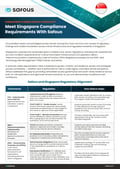
This compliance checklist shows how Safous supports cross-sector compliance in Singapore by governing vendor and privileged access with audit-ready evidence. It is for CII operators, financial institutions, healthcare, government ICT and other regulated organizations, and it maps ten Singapore frameworks to Safous capabilities.
Download the PDF
What the Checklist Covers
| Requirement area | What it requires | How Safous supports it |
|---|
| CSA: Cybersecurity Act and CCoP 2.0 | Mandatory for CII operators: vendor access (§5.1.3), remote connections (§5.7), audits at least every 2 years and annual risk assessments. | JIT access, MFA, approval workflows, session recording, exportable logs, bastionless access and SIEM integration. |
| IMDA: Telecommunications Cybersecurity Code of Practice | Prevention, detection, response and incident management. | Least-privilege remote sessions, MFA, session recording and SIEM-ready logs. |
| PDPC: PDPA | Reasonable security arrangements; notify PDPC within 3 calendar days of determining a breach is notifiable. | Access records, policy-based restrictions, real-time alerts and exportable evidence. |
| MAS TRM Guidelines and Notices | Privileged and remote access controls, logging, third-party governance; root cause report within 14 days (FSM-N05). | JIT, RBAC, MFA, credential vaulting and integrity-protected session recordings. |
| MOH Cyber and Data Security guidelines | Controlled vendor access and audit evidence in healthcare. | JIT and MFA vendor access, session recording and evidence exports. |
| GovTech IM8 | Right-fit controls and System Security Plan evidence. | Time-bound privilege elevation and tamper-evident recordings. |
| SS 584:2020 MTCS | Multi-tier cloud security standard. | Central privileged operations across clouds, activity logs and segmented access. |
| IoT Cybersecurity Guide | IoT lifecycle practices (voluntary unless mandated). | Least-privilege JIT access, MFA, credential vaulting and recordings. |
| CSA Cyber Essentials and Cyber Trust; DPTM SS 714:2025 | Foundational to advanced controls; accountable data protection. | Segmented remote operations, MFA, least privilege, traceability and assessor-ready logs. |
Frequently Asked Questions
Who must comply with CCoP 2.0?
The checklist describes the Cybersecurity Code of Practice (CCoP) 2.0 as a mandatory code for Critical Information Infrastructure (CII) operators under the Cybersecurity Act.
Which Singapore frameworks does the checklist cover?
CSA's Cybersecurity Act and CCoP 2.0, IMDA's Telecommunications Cybersecurity Code of Practice, the PDPA, MAS TRM, MOH guidelines, GovTech IM8, SS 584:2020 MTCS, the IoT Cybersecurity Guide, Cyber Essentials and Cyber Trust, and DPTM SS 714:2025.
Does Safous itself make an organization compliant?
No. Safous helps implement and evidence controls, but the checklist states it does not constitute compliance or replace required approvals and processes.
Related resources: Regulatory compliance with Safous, Third-party access, Privileged remote access guide.