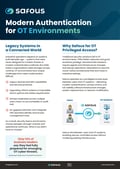
This white paper explains how Safous adds modern authentication, access control and visibility to industrial OT systems that were never designed for them. It is for OT security and operations teams that must protect legacy equipment without compromising uptime or safety. It covers the authentication gaps common in OT and how Safous addresses each one.
Download the PDF
Key Challenges in OT Authentication
- According to the SANS State of OT Security 2025 report (as cited by Dragos), only 14% of surveyed industrial cybersecurity professionals felt fully prepared for emerging OT cyber threats.
- Many industrial systems were built decades ago and lack MFA and modern security protocols.
- Uptime and safety requirements make upgrades difficult.
- Shared credentials remove accountability and audit trails.
- Air-gapped networks do not integrate easily with standard identity and access management tools.
- VPNs, standard PAM and IAM platforms often rely on flat networks, agents or cloud-native assumptions that do not fit OT.
How Safous Helps
- Enforces MFA in front of legacy systems without infrastructure changes.
- Removes shared credentials and enforces user-level accountability.
- Requires approval before access to critical OT systems.
- Secures vendor and contractor access without exposing the network.
- Deploys without changes to networks, firewalls or OT systems.
- Provides full session recording and audit trails for compliance.
Frequently Asked Questions
Can Safous add MFA to legacy OT systems?
Yes. Safous sits as a privileged access layer between users and OT systems and enforces MFA without changing the systems themselves.
How does Safous deal with shared OT credentials?
It removes the need for shared credentials and ties each session to an individual user for accountability.
Does deployment require network or firewall changes?
No. The white paper states Safous deploys without changing networks, firewalls or OT systems.
Learn more: Safous Industrial Secure Remote Access and Privileged Remote Access guide.