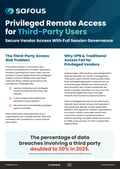
This white paper covers how Safous Privileged Remote Access governs third-party vendor and contractor access to sensitive systems. It is written for security and IT teams responsible for vendor access who need to limit standing privileges and prove who accessed what. It explains why VPNs fall short and compares a VPN-based attack path with an identity-based one.
Download the PDF
Key Challenges in Third-Party Access
- Vendors often keep privileged access longer than their role requires.
- Sensitive requests frequently have no approval workflow.
- Privileged vendor sessions cannot always be audited, so after a third-party breach it is hard to establish what was accessed and by whom.
- VPNs grant network-level access, letting contractors see infrastructure they should not.
- Stolen VPN credentials allow attackers to move laterally inside the network.
How Safous Helps
- Integrates with the identity provider and limits access to the application layer instead of the network.
- Just-in-time, time-bound access with automated approvals that expire automatically.
- Session recording, command logging and transcripts kept within the customer's environment.
- Application-level access without VPNs, shared credentials or software on vendor devices.
- A single platform rather than a multi-module PAM suite, with centralized control and real-time visibility.
Frequently Asked Questions
Why is a VPN a risk for vendor access?
A VPN grants network-level access, so a vendor can see more infrastructure than needed and a stolen credential can be used to move laterally.
How does Safous limit how long vendors keep access?
Access is just-in-time and time-bound, with automated approvals that expire automatically.
Do vendors need to install software?
No. Vendors get application-level access without installing software on their devices and without shared credentials.
Learn more: third-party access and Privileged Remote Access guide.