
At its core, auditability is the ability to create a complete, verifiable record of every critical action taken within your digital systems. In a Zero Trust architecture, auditability is not just documentation — it is proof of enforcement.
It answers the essential security questions: who accessed what, under which identity, for how long, from where, and with what level of privilege. Without this visibility, Zero Trust becomes a concept. With auditability, it becomes enforceable.
Defining Auditability in Simple Terms

Let's use a real-world analogy: business expenses. To get reimbursed, you need a detailed receipt proving what was bought, when, where, and by whom. Without that proof, accountability evaporates. Auditability in tech works just like that receipt, but for every single digital interaction across your organization’s critical systems.
It’s the systematic process of recording and protecting evidence of activities in a way that is both exhaustive and tamper-proof. This goes way beyond simple data logging. True auditability ensures the information collected is reliable enough to accurately reconstruct a sequence of events, creating a single source of truth for security investigations, compliance checks, and operational troubleshooting.
More Than Just a Record
Calling auditability a simple "record" does it a disservice. It’s a foundational security principle that gives you the oversight needed to manage risk effectively. A system with strong auditability lets you:
- Reconstruct Events: Pinpoint the exact steps taken during a security incident or system failure.
- Assign Responsibility: Determine precisely which user or process was responsible for a specific action.
- Detect Unauthorized Activity: Spot suspicious behavior that deviates from normal patterns.
- Prove Compliance: Show auditors, with concrete evidence, that your security controls and policies are actually being enforced.
At its core, auditability transforms abstract security policies into concrete, provable actions. It moves an organization from merely claiming it is secure to being able to prove it, moment by moment.
The Foundation of Trust
Ultimately, what is auditability really about? It's about building and maintaining trust.
It's about earning your customers' trust that their data is protected. It's about earning regulators' trust that you're meeting your compliance duties. And it's about trust within your own organization that actions are monitored and people are held accountable.
Without a clear, unchangeable trail of activity, it's nearly impossible to investigate breaches, enforce policies, or learn from operational slip-ups. This makes robust auditability not just a technical feature, but a core business necessity. It provides the visibility you need to operate securely and confidently, forming the essential groundwork for everything from Remote Privileged Access (RPAM) to protecting critical OT infrastructure.
Why Auditability Is a Business Imperative
Okay, we've defined auditability. But what does it really mean for your business? Its true value isn't on paper; it's in how it protects your most critical operations day in and day out. Think of it less as a compliance checkbox and more as a strategic advantage that guards key assets, keeps things running smoothly, and prevents absolute catastrophes. Without it, you’re flying blind in some very dangerous skies.
This becomes crystal clear when we look at three high-stakes areas where oversight isn't just a good idea—it's completely non-negotiable. These are the places where a single unverified action can spiral into major financial losses, reputational damage, or even physical disruptions.
Securing Remote Privileged Access (RPAM)
Remote privileged accounts hold the proverbial “keys to the kingdom.” Administrators, engineers, and third-party vendors often require elevated access to critical systems across IT and OT environments.
Without controlled, monitored Remote Privileged Access (RPAM), these sessions become among the highest-risk attack surfaces in modern enterprises.
If you don't have a verifiable trail, you can't be sure how those powerful credentials are being used. An administrator might accidentally make a critical configuration error. Even worse, a compromised account could become an attacker's gateway to move silently across your network.
Solid auditability within your RPAM controls provides undeniable answers to the most important questions:
- Who got into the privileged account?
- When did they log in, and for how long?
- What specific commands did they run, and what changes did they make?
This level of detail creates real accountability. It discourages misuse because users know their actions are being recorded. If an incident occurs, it provides your security team with the exact forensic data they need to investigate quickly and shut it down.
A Zero Trust–based RPAM model enforces identity verification, least-privilege access, session recording, and real-time monitoring — without relying on traditional VPN architectures. This reduces lateral movement risk and provides immutable evidence for every privileged session.
Closing Blind Spots in Remote Access
In hybrid IT and OT environments, remote access is unavoidable — whether for contractors, third-party service providers, or employees who need access to specific business applications.
However, traditional VPN-based remote access models create broad network-level exposure. They authenticate users once but rarely enforce granular, identity-based session control.
An identity-centric Remote Privileged Access (RPAM) model limits exposure by connecting users directly to authorized applications — not the entire network. Every session is verified, time-bound, monitored, and fully recorded.
This Zero Trust approach eliminates blind spots by ensuring that each action within a remote session is attributable to a verified identity, reducing lateral movement risk and strengthening third-party governance.
Unlike traditional network-level VPN architectures, application-level connectivity ensures users never gain unnecessary visibility into adjacent systems.
Protecting Critical Operational Technology
Nowhere is the need for auditability more urgent than in Operational Technology (OT) environments. These aren't just IT systems; they control physical processes across sectors such as manufacturing, energy, and transport. An unauthorized change here doesn’t just leak data—it can shut down a factory, trigger a power outage, or cause a public safety crisis.
Many of these OT systems were built long before modern cyber threats were even a thought, making them especially vulnerable. While enabling remote access for maintenance and monitoring is more efficient, it also exponentially increases the risk.
A rock-solid audit trail in OT is essential for:
- Verifying Maintenance: Confirming technicians performed only the approved maintenance tasks.
- Investigating Anomalies: Quickly finding the root cause when a system malfunctions or production grinds to a halt.
- Ensuring Safety and Compliance: Proving that every change to a critical control system was authorized and documented.
Ultimately, auditability in these three domains—Remote Privileged Access (RPAM), remote access, and OT—isn’t just about looking back at what happened.
In industrial environments, auditability supports alignment with standards such as IEC 62443, which requires traceability and access governance.
A Zero Trust–based OT access architecture ensures that remote maintenance sessions are identity-verified, time-bound, and fully recorded — without exposing flat network segments. This is especially critical in manufacturing, energy, and critical infrastructure sectors, where operational uptime and safety are directly impacted by access misuse.
Tying Auditability to Regulatory Compliance
For many organizations, regulatory compliance feels like navigating a maze in the dark. Audit preparation often becomes a last-minute scramble to find evidence and prove that security policies are actually being followed. But when you have solid auditability built into your operations, the dynamic changes. Compliance stops being a stressful, periodic chore and becomes the natural result of strong, everyday security.
Here’s a simple way to think about it: a compliance framework is like a building code. It lays out the non-negotiable standards for safety and integrity. Auditability, then, is your complete set of architectural blueprints, engineering reports, and material receipts that prove your building was constructed precisely to that code. Without those records, you can only claim you're compliant; with them, you can prove it.
The Foundation for Major Standards
Look at any major security or data privacy regulation, and you'll find auditability right at its core. These frameworks don't just ask you to have security controls; they demand verifiable proof that those controls are working, day in and day out. This is where a complete, unchangeable audit trail becomes absolutely essential.
For example, ISO/IEC 27001 Annex A controls related to logging and monitoring require organizations to record, protect, and regularly review security-relevant events. Auditability provides operational evidence that these controls are functioning effectively—not merely documented in policy.
Let’s see how this plays out with some of the most common frameworks:
- ISO/IEC 27001: This global standard for information security management systems (ISMS) requires organizations to constantly monitor, measure, and evaluate their security performance. Audit trails provide the hard data needed for this, showing everything from who accessed sensitive data to precisely when security settings were changed. You can learn more about how Zero Trust principles can fast-track ISO/IEC 27001 compliance in our detailed guide.
- NIST Frameworks: The guidelines from the National Institute of Standards and Technology (NIST), such as NIST SP 800-53 security controls and the NIST Cybersecurity Framework (CSF), emphasize monitoring and accountability. Auditability is the engine that enables organizations to detect unauthorized access, reconstruct security incidents, and generate the detailed logs these controls require.
- GDPR (General Data Protection Regulation): Under GDPR, you have to be able to show that you're protecting the personal data of EU citizens. That means maintaining clear records of data processing, access controls, and incident response. If a breach happens, a strong audit trail is your primary evidence to show regulators that you did your due diligence and responded appropriately.
Having detailed, trustworthy audit logs isn't just about passing an audit. It’s about being able to tell a clear and accurate story of your security posture to regulators, customers, and stakeholders at any given moment.
Organizations leveraging identity-based Remote Privileged Access solutions can more easily demonstrate alignment with frameworks such as ISO/IEC 27001, NIST CSF, and sector-specific standards. Auditability becomes the living proof behind compliance documentation.
Shifting from Reactive Checklist to Proactive Security
Ultimately, strong auditability changes a company's entire compliance mindset. When every critical action is logged, monitored, and recorded, security becomes proactive rather than reactive. Instead of scrambling to find evidence after something goes wrong, security teams have a continuous, real-time view of what's happening.
This state of constant readiness means audit preparation is no longer a massive, disruptive project. The proof you need is already being collected and organized as part of your daily routine. It makes audits smoother and less stressful and builds a culture of accountability in which security is woven into everything. It turns compliance from a dreaded task into a simple validation of the good security you already have in place.
The Building Blocks of a Strong Auditability Framework
To really get what auditability is all about, you have to look under the hood. A solid auditability framework isn't just one piece of software; it's a set of interconnected functions that work together to create a complete, verifiable record of all activity across your systems. Each part has its role, and when they work together, they form a powerful system of checks and balances.
Think of it like building a high-security vault. You wouldn't just install a heavy-duty lock on the front door and call it a day. Of course not. You'd have detailed entry logs, security cameras watching every angle, tamper-proof safes inside, and an alarm system ready to go off at the slightest irregularity. Each of these elements addresses a different aspect of the security puzzle. It's their combined strength that makes the vault truly secure and, just as importantly, auditable. The exact same idea applies to your digital infrastructure.
To give you a clearer picture, let's break down the technical pillars that make a strong auditability framework tick.
Comprehensive Logging: The System’s Diary
At its very core, auditability begins with comprehensive logging. This is the process of recording every significant event across your systems and network. Each log entry is like a line in a meticulously kept diary, noting what happened, exactly when it happened, and which user or system was involved.
But here’s the thing: just collecting logs isn’t enough. For them to be truly useful, they need to be detailed and context-rich. A log that just says "User A logged in" is pretty useless. A good log entry would say, "User A logged in from IP address X on device Y at this specific time, authenticated using MFA, and accessed the primary financial server." See the difference? That level of detail transforms a simple record into actionable intelligence for any security investigation.
Immutable Audit Trails: The Unalterable Record
Once you have all these detailed logs, the next critical step is ensuring no one can tamper with them. This is where immutable audit trails come into play. If an administrator—or worse, an attacker who has stolen admin credentials—can go in and change or delete the logs, your entire audit trail is worthless. It's compromised.
An immutable record is like a contract written in indelible ink and stored in a tamper-proof vault. Modern technologies such as cryptographic hashing and write-once-read-many (WORM) storage ensure that once a log entry is created, it's immutable. This guarantees the integrity of your audit data, making it reliable, trustworthy evidence for forensic investigations and compliance checks.
The infographic below shows how a strong auditability framework, built on these core principles, is essential for meeting major compliance standards.
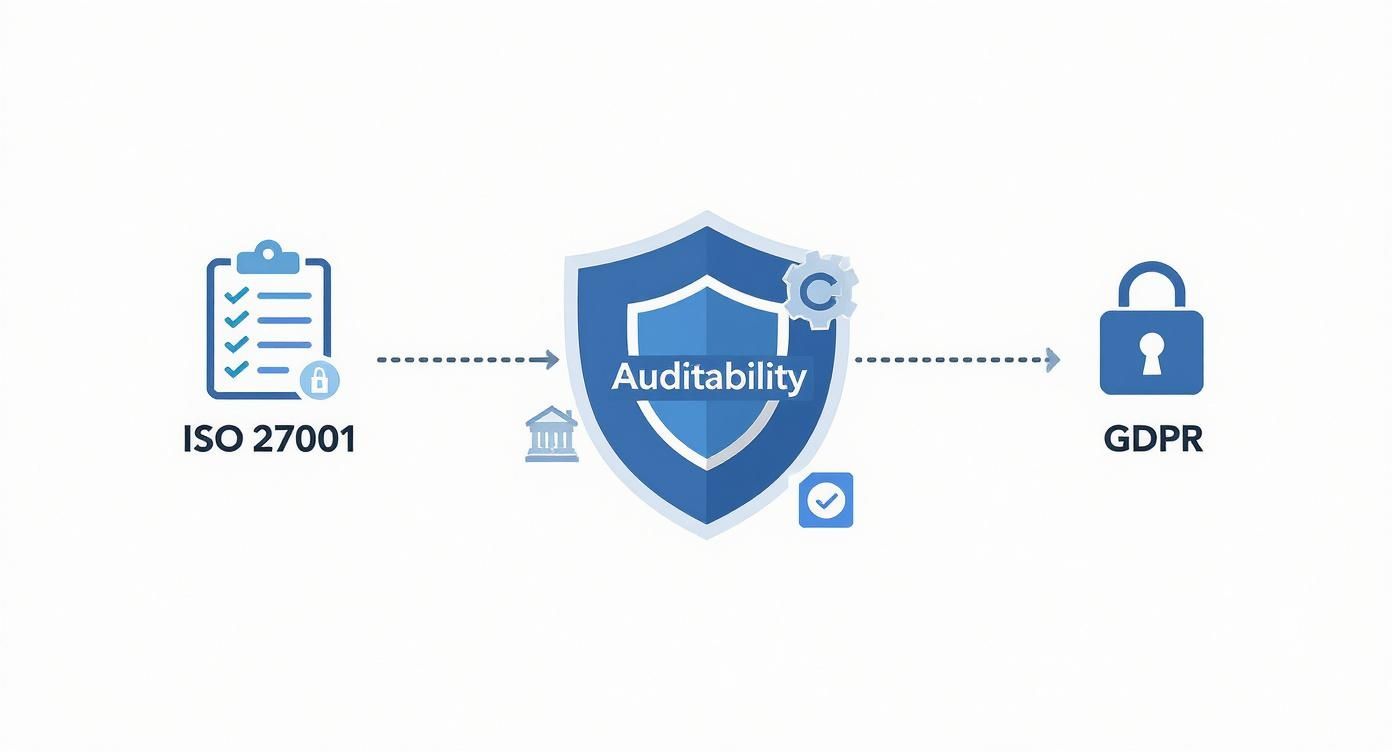
As you can see, auditability isn't just some isolated technical feature. It's the fundamental proof you need to show you’re sticking to the rules laid out by key regulatory frameworks.
Session Recording: The Security Camera
While logs tell you what happened, session recording shows you exactly how it happened. Think of it as a security camera watching over a user's shoulder during a privileged session. It captures every single click, keystroke, and command they execute on a critical system.
This is absolutely vital for investigating incidents involving privileged users. If a misconfiguration accidentally takes down a production server, reviewing the session recording can pinpoint the exact mistake. For a deeper dive into managing high-risk privileged access, check out our guide covering 11 essential Privileged Access Management best practices. This kind of visual proof provides an unambiguous context that plain-text logs can't match.
A complete audit trail doesn't just list events; it tells the full story. Session recordings provide the visual narrative, offering irrefutable evidence of user actions from start to finish.
The table below summarises the core technical pillars we've discussed, highlighting why each one is so crucial for both security and compliance.
Key Technical Components Of Auditability
| Component | Primary Function | Criticality for Auditability |
|---|---|---|
| Comprehensive Logging | Records all system, user, and application events in detail. | Forms the foundational data layer. Without logs, there is nothing to audit. |
| Immutable Audit Trails | Ensures that log data cannot be altered or deleted once recorded. | Guarantees the integrity and trustworthiness of the audit evidence. |
| Session Recording | Captures a visual record of user activity during a privileged session. | Provides clear context and visual evidence of the actions taken. |
| Chain of Custody | Tracks the lifecycle of data and commands to prove they weren't tampered with. | Establishes the authenticity of evidence from origin to destination. |
| Real-Time Alerting | Automatically flags suspicious activities as they happen. | Enables proactive security response instead of reactive investigation. |
These components work in concert to create a robust system of accountability. Now let's look at the final pieces of the puzzle.
Chain of Custody and Real-Time Alerting
Two final components wrap up the framework, ensuring both the integrity of your data and the speed of your security response.
- Chain of Custody: A concept borrowed from law enforcement, it refers to the chronological documentation of evidence. In the IT world, it means tracing a piece of data or a command from its origin to its destination, demonstrating that it wasn't altered along the way. It ensures the entire action lifecycle is auditable and trustworthy.
- Real-Time Alerting: This is your system’s instant alarm. Instead of waiting hours or days to review logs after an incident, real-time alerting automatically flags suspicious behavior the moment it occurs. This could be a user trying to access a file they shouldn't or an admin logging in from an unusual location. This allows security teams to respond immediately, preventing a potential breach from escalating.
Together, these building blocks—logging, immutability, session recording, chain of custody, and alerting—create a formidable framework. They ensure that every action is not only recorded but also protected, contextualized, and monitored, giving you the visibility you need for modern security and compliance.
How to Measure Your Auditability Success
Knowing the building blocks of auditability is one thing. Proving your framework is actually working is another challenge entirely.
How do you move beyond a simple pass/fail audit and demonstrate real, tangible security improvements? The secret is to track specific, practical Key Performance Indicators (KPIs) that translate your technical efforts into measurable business value.
Think of it this way: just as a business tracks revenue and expenses to check its financial health, security leaders need to track key metrics to measure their auditability. These numbers give you the hard evidence needed to justify security spending, guide improvements, and prove to stakeholders that risks are being managed effectively. Without them, you're just guessing.
Moving Beyond the Basics with Actionable KPIs
Effective measurement starts by picking the right KPIs. You need to look past simple log counts and focus on the speed, efficiency, and completeness of your audit processes. Tracking these metrics helps you benchmark performance and pinpoint areas for improvement.
Here are a few key indicators of strong auditability:
- Mean Time to Detect (MTTD): This is the average time it takes for your team to spot a security incident from the moment it starts. A low MTTD is a great sign that your real-time alerting and monitoring systems are on the ball.
- Mean Time to Respond (MTTR): Once you’ve detected an incident, how quickly can your team shut it down and fix the damage? This KPI depends on having a clear, accessible audit trail to rapidly understand what happened.
- Audit Trail Generation Time: When an incident occurs or an auditor requests it, how long does it take you to compile a complete, end-to-end audit trail for a specific user, asset, or time period? A solid system should do this in minutes, not days.
- Percentage of Privileged Sessions Reviewed: You don't need to review every single privileged session, but tracking this metric for high-risk activities is crucial for accountability. It shows you’re being proactive, not just reacting to problems.
Strong auditability isn’t just about collecting data; it’s about how quickly and accurately that data can be turned into actionable insight. A low MTTD and rapid audit trail generation are clear signs of a mature and effective security framework.
Connecting Metrics to Broader Business Goals
These metrics are vital for your internal security team, but they also tell a bigger story for the business. The struggle to maintain high-quality audit processes isn't unique to cybersecurity.
By tracking security KPIs, you build trust and demonstrate due diligence to regulators, partners, and customers. Presenting a consistently low MTTR, or demonstrating that 100% of critical system changes are logged and reviewed, provides undeniable evidence of a strong security posture. It changes the conversation about security from a cost center to a business enabler, demonstrating that your organization is a trusted guardian of sensitive data and critical infrastructure. This kind of proactive measurement is the final step in truly mastering auditability.
Practical Steps to Implement Better Auditability

Knowing the "what" and "why" of auditability is one thing, but putting it into practice is what actually hardens your security. A successful rollout isn't just about plugging in new tools. It demands a coordinated effort across your technology, processes, and people to build a real culture of accountability.
Think of this as a roadmap to get you from theory to reality. It's a practical checklist for building a solid technical framework and fostering a security-first mindset across your organization.
Establish a Centralized Logging System
First things first: you need to centralize all your log management. When logs are scattered across different servers, apps, and network devices, you’re left with massive blind spots. Investigating an incident becomes a nightmare. Pull them all into a single, secure location.
With a centralized system, your security team can finally connect the dots and correlate events across your entire infrastructure. This gives you a unified view of all activity, making it far easier to spot suspicious patterns and trace the exact path of an attack from start to finish.
Enforce the Principle of Least Privilege
One of the most powerful security principles is also one of the simplest: the principle of least privilege (PoLP). It’s a straightforward idea—every user, application, and system should only have the absolute minimum permissions needed to do their job. Nothing more.
By strictly enforcing PoLP, you dramatically reduce your attack surface. If a user account is compromised, the potential damage is limited because its permissions are so restricted. This approach is the bedrock of a Zero Trust security model, which you can read more about in our guide on how ZTNA ensures secure remote access.
Auditability without least privilege is like having security cameras watching an unlocked vault. You'll have a perfect recording of the theft, but you did little to prevent it in the first place.
Conduct Regular Access Reviews
Permissions can't be a "set it and forget it" task. People change roles, employees leave, and projects wrap up. That’s why regular access reviews are non-negotiable. You need to schedule periodic audits—at least quarterly or semiannually—to confirm that all user access rights remain appropriate and necessary.
This routine cleanup stops "privilege creep," which occurs when users gradually accumulate unnecessary access rights, creating gaping security holes. It’s a crucial check-and-balance that keeps your access controls tight and aligned with your current business needs.
Common Questions About Auditability
As you get to grips with what auditability really means and why it’s so important, a few practical questions always pop up. Let’s tackle some of the most common ones to clear up any confusion and nail down how these concepts work in the real world.
What Is the Difference Between Logging and Auditability?
It’s easy to mix these two up, but they represent very different stages of security oversight.
Think of logging like the raw footage from a security camera. It’s the simple act of recording every single event that happens—a user logging in, a file being changed, a setting being adjusted. It’s the essential first step, the raw data feed.
Auditability, on the other hand, is what lets you take all that raw footage and piece together a coherent, verifiable story of what happened. It’s about ensuring those logs are not only collected but also complete, tamper-proof, rich in context, and easy to search. Logging collects the evidence; auditability turns that evidence into trustworthy intelligence you can use to reconstruct events and prove compliance.
How Can Small Businesses Improve Auditability on a Budget?
You don't need a massive budget to strengthen your auditability. Small businesses can make huge strides by focusing on high-impact, low-cost practices. The idea is to build a solid foundation without a huge upfront investment.
Here are a few practical places to start:
- Enforce the principle of least privilege. This is the simplest yet most powerful step you can take. Ensure people have access only to the systems and data they need to do their jobs. Nothing more.
- Centralise your logging. Use the built-in logging features of your operating systems and key applications, but funnel them all into a single, secure location. This makes reviewing them infinitely easier.
- Establish clear written policies. Get your rules for access control, password management, and acceptable use in writing. This creates a clear standard that everyone can follow.
- Explore modern cloud-based solutions. Many security platforms now offer enterprise-grade auditability features on an affordable subscription model, putting advanced tools within reach.
Is Auditability Only Important for Regulated Industries?
Absolutely not. While compliance mandates in sectors such as finance and healthcare make auditability non-negotiable, it’s a fundamental pillar of good governance for any organization.
Think about it. Any business that handles sensitive customer data, valuable intellectual property, or critical operational systems needs a reliable way to track what’s going on. Strong auditability helps you investigate security incidents faster, resolve internal disputes with hard evidence, and even improve operations by spotting errors. Ultimately, it’s about building deeper trust with your customers. It's a core part of modern cybersecurity, no matter what industry you're in.
Achieve comprehensive, compliance-ready auditability for your privileged users and third-party vendors with Safous.
Our Zero Trust–based Remote Privileged Access (RPAM) platform delivers granular identity-based control, session recording, and immutable audit trails to secure your hybrid IT and OT environments—without exposing your network through traditional VPN architectures.
Discover how Safous can strengthen your security posture and compliance readiness.
Subscribe with Safous
Receive the latest news, events, webcasts and special offers!
Share this
Managing Supply Chain Cyber Risk: A CISO’s Guide to Operational Resilience

Managing Supply Chain Cyber Risk: A CISO’s Guide to Operational Resilience
Apr 28, 2026
12
min read
Why Identity Governance Needs to Include Human and Machine Users

Why Identity Governance Needs to Include Human and Machine Users
Nov 10, 2025
5
min read
Cyber Threats in Finance: Why Zero Trust Access Is Essential

Cyber Threats in Finance: Why Zero Trust Access Is Essential
Oct 09, 2024
4
min read