

In today’s environment, however, segregation of duties (SoD) can no longer be limited to internal financial processes. As organizations adopt remote maintenance, third-party vendor access, and hybrid IT/OT connectivity, SoD must extend to how privileged access is granted, approved, and monitored — especially in remote scenarios. This shift is driving increased focus on Remote Privileged Access Management (RPAM) as a structural control mechanism rather than merely a technical safeguard.
Segregation of duties is one of those foundational internal controls that every organisation needs to get right. At its simplest, it just means splitting a critical task into different parts and assigning each part to a different person. This is done to prevent both fraud and simple mistakes.
Think of it like the classic bank vault that requires two separate keys to open. No single person has enough power to act unilaterally, creating a natural system of checks and balances. It’s a simple but incredibly powerful principle, and honestly, it’s a cornerstone of solid business security and operational integrity.
Understanding the Core Idea of Segregation of Duties

At its heart, SoD is a strategy for building checks and balances directly into your business processes. It’s designed to ensure that no single employee has end-to-end control over a sensitive transaction, making it significantly harder for fraudulent activity to occur without detection.
When you divide responsibilities this way, you create a system where one person’s work is automatically verified by another. This internal control framework really boils down to three main goals:
- Preventing Fraud: The most obvious benefit. By separating tasks such as authorising a payment from processing it and then reconciling the account, you make it nearly impossible for one person to create and conceal a fraudulent transaction.
- Detecting Errors: People make mistakes. When multiple people are involved in a process, the odds of catching an accidental error go way up. For instance, the person reconciling a bank statement can easily spot a mistake made by the person who recorded the initial payment.
- Promoting Transparency: When roles are clearly separated, accountability skyrockets. Everyone knows exactly what they’re responsible for, creating a more transparent and easily auditable environment.
Dismantling the Fraud Triangle
A useful framework for thinking about internal threats is the "Fraud Triangle." It identifies the three elements typically present when fraud occurs: Pressure, Rationalisation, and Opportunity. An employee might feel financial pressure, rationalise that they deserve the money, and then act—if they have the chance.
Segregation of duties directly attacks and dismantles the ‘Opportunity’ leg of the Fraud Triangle. By removing the ability for one person to control an entire process, you eliminate the single most critical element required to commit fraud.
This isn’t just a financial control, either. It applies across the entire organisation, from IT administration to inventory management. A developer who writes code, for example, shouldn't be the same person who deploys it to the live production environment. This separation prevents unauthorised changes and enhances the system's security.
By implementing SoD, you're not just ticking a compliance box; you're building a more resilient operational structure. This concept also works hand in hand with other crucial security principles. In fact, you should explore our detailed guide on the principle of least privilege access, which further limits user permissions to only what is absolutely necessary for their job.
In highly regulated environments, segregation of duties is widely recognized as a foundational control in financial governance and operational oversight.
The Hidden SoD Risk in Remote Privileged Access
In many modern environments, the greatest SoD breakdown does not occur in accounting systems, but in remote access workflows.
For example:
- A vendor may request remote access and be granted standing administrative privileges.
- The same administrator may approve, execute, and modify configurations without independent oversight.
- Shared super-admin accounts may eliminate accountability altogether.
When remote privileged access lacks proper segregation, the “opportunity” element of the Fraud Triangle expands significantly — often beyond internal employees to include contractors and third parties.
Why SoD Is a Cornerstone of Business Security
Moving from theory to real-world consequences, it becomes crystal clear why segregation of duties (SoD) is a non-negotiable part of modern business security and resilience. This isn't just some abstract accounting concept; it's a practical shield that protects your most valuable assets, keeps you on the right side of regulators, and brings stability to your operations. Without it, you’re leaving the door wide open to serious financial and reputational harm.
The link between strong SoD and major governance frameworks is direct and powerful. Regulations such as the US Sarbanes-Oxley Act (SOX) and principles embedded in privacy laws like the GDPR all require robust internal controls. When auditors come knocking, one of the first things they scrutinise is the separation of critical functions. It’s a key sign of a healthy control environment. Failing an audit due to weak SoD can trigger steep fines, legal issues, and a swift decline in investor confidence.
Protecting Your Most Valuable Assets
Beyond just ticking compliance boxes, SoD is fundamentally about protecting what matters most. That includes everything from company cash and sensitive customer data to your priceless intellectual property. When a single person can both initiate and approve transactions, the potential for financial fraud skyrockets.
Picture this: a mid-sized company had a trusted finance employee responsible for creating new vendor profiles and processing payments. Over 18 months, this person created a phantom vendor with their own bank details, funnelling over $250,000 in fake payments to themselves. The scheme was only uncovered during a routine external audit. It wasn't a sophisticated hack; it was a simple, devastating exploitation of a single point of failure.
This story drives home a critical truth: most internal fraud isn't the work of a criminal mastermind. It's the result of an opportunity created by poor internal controls. A simple separation of duties—one person to set up vendors, another to approve payments—would have stopped this scheme in its tracks.
Driving Operational Efficiency and Accuracy
Good SoD controls also have a surprisingly positive effect on your day-to-day operations. When roles and responsibilities are clearly defined and separated, processes run more smoothly and become more transparent. This clarity reduces confusion and creates natural checkpoints that catch costly errors before they cause real disruption.
Here’s how clear role separation makes things better:
- Clarified Responsibilities: Employees know exactly what they are accountable for, which reduces overlap and wasted effort.
- Natural Error Detection: When one person’s work is reviewed by another as part of the normal flow (like a manager approving an expense report), mistakes are caught early.
- Enhanced Accountability: It becomes much easier to trace actions to specific individuals, encouraging diligence and reducing the likelihood of negligence.
This structure also prevents a single point of failure from halting a critical process. Shared super-admin accounts, for example, are a notorious SoD violation and a massive security risk. To see just how devastating this practice can be, you can read about three data breach disasters caused by shared super admin accounts, which really underscore the need for strict role separation in IT. By building a framework of checks and balances, you create a more resilient, accurate, and secure organisation from the ground up.
How to Build Your Segregation of Duties Framework
Knowing that segregation of duties is important is one thing, but actually putting it into practice requires a clear plan. Building a solid SoD framework isn't just about drafting new policies that sit on a shelf. It’s about weaving a system of checks and balances directly into your company’s day-to-day operations.
This is how you turn abstract security ideas into concrete actions that protect your organisation from the inside out.
The first move is to pinpoint your critical business processes. Consider the high-stakes areas such as procurement, payroll, and financial reporting. For each one, you’ll need to break it down into its basic functions: who authorises actions, who has custody of assets, who keeps the records, and who reconciles everything.
This mapping exercise is critical because it immediately highlights where your single points of failure might be. It prompts you to ask the tough questions: Can a single person add a new vendor and approve payments to them? Can a single IT admin create a user account and assign its permissions without any oversight?
Create a Segregation of Duties Matrix
Once you’ve mapped out these functions, the next step is to build an SoD matrix. At its core, this is a simple grid—often just a spreadsheet—that maps employee roles against the specific tasks they are allowed to perform. Think of it as a visual tool for spotting potential conflicts where one person holds too much power.
Your matrix should clearly lay out:
- Business Processes: List every critical workflow (e.g., Procure-to-Pay, Order-to-Cash).
- Key Tasks: Break down each process into its individual steps (e.g., Create Purchase Order, Approve Invoice, Process Payment).
- Employee Roles: List all relevant job titles or user roles.
- Permissions: Mark which roles can perform which tasks.
This document becomes the blueprint for your internal controls. It makes identifying and fixing risks much easier before they can be exploited, and auditors will absolutely want to see it.
The process flow below illustrates the real-world benefits of a well-designed SoD framework, moving from simple compliance to asset protection and smoother operations.
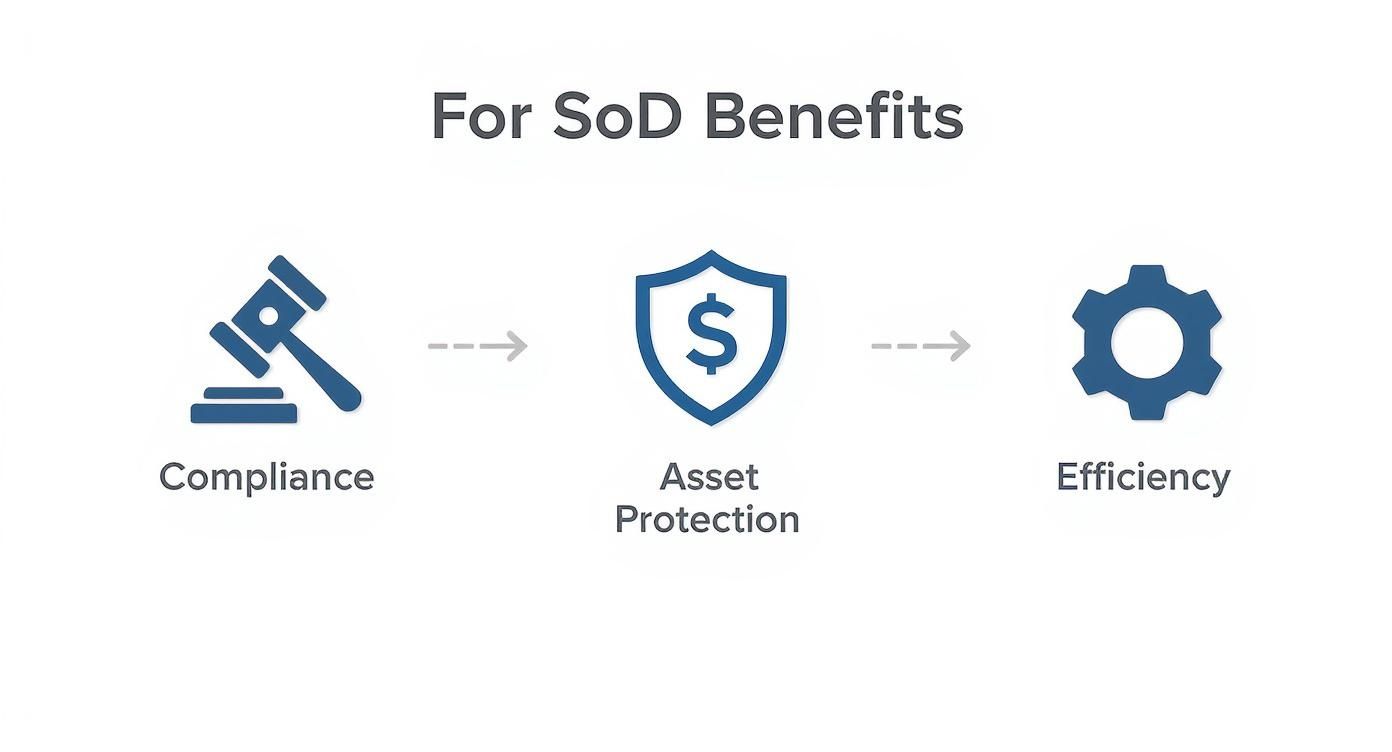
This visual illustrates how one control framework can deliver multiple benefits that build on one another, from meeting regulations to a more efficient and reliable organisation.
Implement Role-Based Access Control
With your SoD matrix as a guide, the logical next step is to automate the enforcement of these rules. Role-Based Access Control (RBAC) is an effective way to ensure users can access only the systems and data they need to do their jobs. Instead of giving permissions to individuals one by one, you create standardised roles like 'AP Clerk' or 'Sales Manager' with pre-defined access rights.
By implementing RBAC, you systemise your SoD policy. The system itself prevents a user assigned the 'AP Clerk' role from performing tasks reserved for the 'Finance Approver' role, effectively automating enforcement and reducing human error.
This doesn't just tighten security; it also massively simplifies user access management. When someone changes jobs, you just assign them a new role instead of spending hours manually reconfiguring dozens of individual permissions. This approach is a cornerstone of good access governance. In fact, you can explore our 11 essential privileged access management best practices to see how RBAC fits into the bigger security picture.
Document and Train Your Team
Finally, a framework is useless if people don’t understand or follow it. Good documentation is non-negotiable for consistency. It’s also a vital tool for training new staff and getting through audits smoothly.
Your documentation should include:
- Clear Policies: A formal document stating the organisation's commitment to SoD.
- Process Workflows: Diagrams that visually show how tasks are separated.
- The SoD Matrix: The detailed map of roles and their permissions.
- Approval Chains: Clearly defined hierarchies for who can authorise what.
Evidence from public-sector reform efforts shows that weak or ignored SoD policies are frequently cited as root causes of fraud. This data shows just how critical these controls are in any anti-fraud strategy. By documenting everything, training your team, and consistently enforcing your framework, you build a more resilient and accountable work environment.
Segregation of Duties in Action Across Departments

Theory is one thing, but seeing segregation of duties (SoD) in practice is where it all clicks. This principle isn't just for the finance team to worry about; it's a critical control that should extend across the entire organisation, from the stockroom to the server room. When you get it right, SoD forms an invisible yet powerful barrier against both fraud and expensive mistakes.
Let’s look at how SoD actually works in different parts of a business, turning abstract rules into something tangible.
In Finance and Accounting
The procure-to-pay cycle is a classic high-risk area, which makes it the perfect place to see SoD in action. If a single employee controls the entire process, they pose a significant threat to the business.
Here’s how to split up those duties correctly:
- Requesting a Purchase: An employee from any department needs something and submits a formal purchase requisition.
- Approving the Purchase: A manager reviews the request. They're checking to ensure it's a valid business expense and within budget before signing off. Critically, this is not the same person who made the request.
- Processing the Payment: The accounts payable team gets the approved invoice and pays the vendor. They have no authority to approve purchases.
- Reconciling the Account: A separate accountant reconciles the bank statements against the payment records, providing an independent check of the process.
By splitting these four roles—requesting, approving, paying, and reconciling—you build a system of checks and balances. It becomes incredibly difficult for someone to create a fake invoice and pay themselves.
In Information Technology
The stakes in the IT department are just as high, if not higher. A developer with unchecked access could slip malicious code into production, and an administrator with too much power could change sensitive data and then cover their tracks. Strong SoD is simply non-negotiable here.
A core principle in secure IT operations is that the person who writes the code should never be the person who deploys it to production. This separation ensures that a second pair of eyes reviews all changes, catching potential bugs or security vulnerabilities before they go live.
In remote privileged environments, proper segregation of duties must also apply to how elevated access is requested, approved, and executed.
For example:
- The user requesting administrative access should not be the same individual approving it.
- Privileged access should be time-bound and task-specific (Just-in-Time).
- All privileged sessions should be independently monitored or recorded.
Without these controls, a single administrator could request, approve, execute, and conceal privileged actions — effectively bypassing SoD in remote scenarios.
This same logic applies to managing user access. No one should be able to create a new user account and assign permissions without oversight. Splitting these tasks stops someone from creating "ghost" accounts with excessive privileges that could be used to siphon off data.
When Segregation of Duties Fails
Ignoring SoD can be devastating. Imagine a real-world scenario in which one employee was responsible for both adding new vendors to the system and processing their payments. Over several years, they simply set up a shell company, created fake invoices, and funnelled hundreds of thousands of dollars into their own bank account. The fraud went completely unnoticed because no one else was involved to question the strange transactions.
Another common failure occurs when a system administrator can both modify critical data and delete audit logs. After making unauthorised changes to financial records, they can just delete the evidence. This total lack of oversight makes spotting malicious activity almost impossible until it's far too late.
Rapid growth environments often experience control breakdowns when critical financial or administrative functions are concentrated in a single individual. Without proper segregation of duties, these structural weaknesses frequently become root causes of internal fraud cases.
Solving Modern Segregation of Duties Challenges
On paper, implementing a solid segregation of duties (SoD) framework seems straightforward, especially in a big, well-resourced company. But today’s work environments are messy and dynamic, presenting hurdles that demand more creative solutions. The good news? Strong controls are still absolutely achievable.
The trick is to adapt the core principles of SoD to fit your real-world operations—whether you’re dealing with a tiny team, a complex IT/OT landscape, or a growing reliance on outside partners.
Handling SoD in Small Teams
For small businesses and startups, the biggest roadblock is usually a simple lack of people. When one person has to wear multiple hats, forcing a strict separation of duties can feel impossible. Try to enforce it too rigidly, and you might grind the whole operation to a halt. Ignore it, and you’re wide open to risk.
The answer lies in compensating controls. Think of these as alternative safety measures that step in to reduce risk when perfect role separation isn’t feasible. They add a crucial second layer of review and oversight.
Here are a few practical compensating controls for smaller teams:
- Ramp Up Management Oversight: If one employee is responsible for both invoicing and payment processing, a manager or the business owner must conduct mandatory, frequent reviews of their work. This could be as simple as a weekly check: matching bank statements against the invoices sent.
- Lean on Automated Monitoring and Alerts: Technology can be a massive help here. Modern accounting or ERP systems can be configured to automatically flag weird activity—like payments made after hours or sudden changes to a vendor’s bank details—and shoot an immediate alert to a manager.
- Rotate Duties Periodically: Whenever possible, rotating critical financial tasks among employees is a great way to uncover irregularities that might otherwise stay hidden.
When you can't achieve perfect separation, the goal shifts. You just need to make sure no critical action ever goes completely unreviewed. Compensating controls are your safety net, making it much harder for fraud or errors to go unnoticed for long.
Managing Risks in Hybrid IT and OT Environments
The convergence of Information Technology (IT) and Operational Technology (OT) brings unique SoD headaches. In environments such as manufacturing plants and power utilities, IT staff may need access to sensitive industrial control systems (OT) that blur traditional security boundaries.
Think about it: an IT admin who manages user access on the corporate network shouldn't also have free rein over the OT systems running the factory floor. A single compromised account could suddenly lead to both a data breach and a physical shutdown.
To tackle this, organisations have to:
- Enforce Strict Access Segmentation: Define distinct roles and permissions for your IT and OT environments. Access to any OT system should be granted strictly on a need-to-know, least-privilege basis.
- Use Privileged Access Management (PAM): Modern Privileged Access Management (PAM) platforms can support this by enforcing temporary, task-specific access and automatically revoking elevated privileges once work is complete. They can enforce SoD by giving users temporary, just-in-time access for a specific task and then automatically revoking it. This eliminates persistent, high-level privileges that could be exploited.
- Monitor All Cross-Domain Activity: Implement session recording and detailed monitoring for any user who moves from the IT network to an OT system. This creates an airtight audit trail that serves as both a powerful deterrent and a way to identify issues after the fact.
Extending SoD to Third-Party Vendors
Increasingly, we rely on third-party vendors, contractors, and managed service providers (MSPs) that require privileged access to our internal systems. This adds another layer of complexity, as your internal controls must extend beyond your own employees.
For instance, a vendor managing your cloud infrastructure could potentially have the power to both spin up new resources and approve the bills for them—a clear conflict of interest. It's critical that your SoD policies apply just as rigorously to all your external partners.
In remote maintenance environments, this risk becomes even more pronounced.
Vendors often require privileged access to production systems for troubleshooting, patching, or configuration changes. Without enforced SoD:
- Vendors may retain standing administrative credentials.
- Approval workflows may be informal or undocumented.
- Session activity may lack independent oversight.
To properly enforce SoD in remote vendor access:
- Access should require internal approval prior to activation.
- Privileges should be identity-based and time-limited.
- Sessions should be monitored and recorded for auditability.
This aligns the principles of segregation of duties with Zero Trust access governance.
Here are a few strategies for getting a handle on third-party risk:
- Make It Contractual: Your vendor agreements must explicitly require vendors to comply with your SoD policies. No exceptions.
- Create Role-Based Vendor Accounts: Never, ever share your internal admin accounts. Instead, create specific, role-based accounts for vendors that grant them the absolute minimum level of access they need to do their job.
- Get Granular with Access Controls: Use a zero-trust access solution to give vendors access only to specific applications or systems, not your entire network. And make sure all their sessions are monitored and recorded.
By facing these modern challenges head-on, you can build a resilient SoD framework that truly protects your organisation, no matter how complex your operations get.
How SoD Fits into a Zero Trust Security Strategy
The old security playbook—a strong castle wall with a trusted kingdom inside—just doesn't cut it anymore. With sophisticated threats and workforces scattered across the globe, the focus has shifted to a much smarter approach: Zero Trust. The philosophy is simple but powerful: never trust, always verify.
Instead of granting users a free pass once they're inside the network, Zero Trust requires constant verification for every access request. This is where the classic principle of segregation of duties (SoD) finds its perfect modern-day partner. SoD builds the logical fences to prevent any one person from holding too much power, while Zero Trust acts as the security guard that checks IDs at every gate.
In practice, Zero Trust operationalizes segregation of duties through:
- Identity-based access segmentation
- Just-in-Time privileged elevation
- Continuous session monitoring
- Elimination of shared super-admin accounts
Rather than relying on static policy documents, Zero Trust platforms enforce SoD dynamically at the point of access.
When you weave them together, you get a proactive, layered defence that’s far tougher for attackers to crack. Zero Trust provides the muscle for enforcement, while SoD provides the blueprint for what "verified" and appropriate access actually looks like.
In distributed enterprises, enforcement at the access layer — rather than relying on perimeter controls — is what makes SoD practically enforceable.
Traditional perimeter-based controls cannot enforce segregation of duties once a user is inside the network; access-layer verification is essential for maintaining separation in modern environments.
Enforcing Granular SoD with PAM
Privileged Access Management (PAM) is a core component of any Zero Trust architecture and enables SoD to operate at a granular level. PAM solutions are built specifically to manage, monitor, and lock down the accounts with elevated permissions—the real "keys to the kingdom."
A game-changing feature of modern PAM is Just-in-Time (JIT) access, which is a huge win for enforcing SoD. Do not grant administrators standing, always-on privileges. JIT access is much more precise:
- A user requests temporary, elevated access to do a specific, approved task.
- The system grants access only for that task and only for a short, predefined time.
- Once the job is complete or the timer expires, the permissions are automatically removed.
This process ensures that powerful credentials are never left lying around, exposed and vulnerable. It directly supports SoD by making it practically impossible for a single user to retain conflicting permissions over time, significantly reducing the window of opportunity for misuse.
Zero Trust isn't just about checking IDs at the front door; it's about continuously validating every privileged action inside the network. By building your SoD rules into a PAM platform, you ensure even legitimate users can't wander outside their designated swim lanes.
Session Monitoring as a Compensating Control
Look, even with the most carefully crafted SoD policies, life happens. Sometimes, temporary exceptions are necessary, or achieving perfect separation isn't practical. In these moments, Zero Trust offers a powerful safety net: session monitoring and recording.
When a privileged user logs into a critical system, a Zero Trust platform like Safous can record everything they do—every keystroke, mouse click, and command typed. This creates a complete, tamper-proof audit trail of their activity.
This kind of visibility pulls double duty:
- Deterrence: People act differently when they know they're being watched. The knowledge that every move is recorded is a powerful deterrent against malicious or sloppy behaviour.
- Forensics: If something does go wrong, the session recording is invaluable. It provides security teams with a play-by-play of the incident, showing them exactly what happened and how to prevent it from happening again.
Segregation of duties is no longer just an accounting safeguard — it is a core security principle that must extend to remote privileged access.
As organizations embrace hybrid IT/OT connectivity and third-party remote maintenance, enforcing SoD at the access layer becomes critical to preventing abuse, limiting insider risk, and strengthening operational resilience.
By combining SoD with Zero Trust access governance, organizations can ensure that no single individual—internal or external—can request, approve, execute, or conceal privileged actions without independent oversight.
Common Questions About Segregation of Duties Answered
As you start weaving segregation of duties (SoD) into your internal controls, you're bound to run into some practical questions. Applying these principles isn't always straightforward, especially when you're juggling unique business needs or a small team. Let's tackle some of the most common hurdles organisations face when implementing SoD.
Think of this as your field guide to navigating those real-world challenges and building a much stronger, more resilient control environment.
How Can a Small Business Implement SoD with Limited Staff?
This is a classic dilemma. For small businesses, having enough people to fully assign every duty is often a luxury they can't afford. The trick is to start by focusing on your highest-risk areas—think cash handling, payroll, and payments. From there, you use compensating controls to cover the remaining gaps.
For example, if the same person must create invoices and receive payments, the business owner or a manager can perform a mandatory weekly account reconciliation. Other simple but effective tactics include rotating critical duties among employees periodically and enforcing mandatory vacations. It's amazing how often these practices help uncover irregularities that might otherwise stay hidden.
What Is an SoD Matrix and Why Is It Important?
An SoD matrix is a simple but powerful tool, usually just a spreadsheet, that maps out user roles against the specific business tasks or system permissions they have. Its real value is how it visually flags potential conflicts where one person has access to multiple sensitive steps in a critical process.
Think of it as the blueprint for your internal controls. The matrix gives you a systematic way to spot and fix SoD risks before they can be exploited. It also serves as clear proof for auditors that your controls are well-thought-out and intentionally enforced.
This document is essential for configuring access rights in systems such as your ERP. It’s a foundational piece for both designing and auditing your entire security setup.
How Does Technology Help Enforce Segregation of Duties?
Relying on manual checks for SoD is a recipe for human error. This is where automation becomes your best friend, enforcing your policies reliably and in real time.
For instance:
- An ERP system can be configured to prevent a user who submitted a purchase order from also approving it. No workarounds.
- Identity and Access Management (IAM) platforms automatically enforce role-based access controls, ensuring users can access only the systems they need to perform their jobs.
- Modern security tools can continuously scan for SoD violations and fire off immediate alerts, so you can investigate right away.
This kind of technological enforcement is worlds more effective than finding a conflict during a quarterly audit. It allows you to mitigate risks the moment they arise.
At Safous, segregation of duties is enforced directly at the access layer through identity-based controls, Just-in-Time privileged elevation, and session monitoring. This allows organizations to operationalize SoD across distributed IT, OT, and third-party environments — without relying on shared credentials or static perimeter defenses. Secure your critical assets and simplify compliance by visiting https://www.safous.com.
Subscribe with Safous
Receive the latest news, events, webcasts and special offers!
Share this
Three Data Breach Disasters Caused by Shared Super Admin Accounts
Three Data Breach Disasters Caused by Shared Super Admin Accounts
Apr 24, 2023
3
min read
Why Human-Approved Access Matters for AI-Automated Operations

Why Human-Approved Access Matters for AI-Automated Operations
Nov 26, 2025
5
min read
Why SASE Doesn’t Meet OT Security Needs, and What to Do Instead

Why SASE Doesn’t Meet OT Security Needs, and What to Do Instead
Jan 08, 2026
5
min read