
A record retention policy defines which records an organization keeps, how long it keeps them, when the retention period begins, where it stores the records, and how it securely disposes of them.
The need for a clear policy often becomes obvious during an incident. Legal asks for a privileged-session recording. Security discovers that the platform retained it for only 30 days. IT can find the account, ticket, and server logs, but the artifact that could answer the investigator's question is gone.
Retention is therefore more than an administrative task. It supports auditability, investigations, privacy, legal readiness, and controlled disposal. A defensible policy helps an organization preserve necessary evidence without keeping every record indefinitely.
Key Takeaways
- A retention policy sets the organization's rules; a retention schedule applies those rules to specific record classes.
- Every schedule entry should identify the record class, owner, trigger, retention period, system of record, hold process, and disposal method.
- Retention periods should be based on applicable laws, regulations, contracts, business needs, privacy obligations, and investigation requirements.
- A legal hold must suspend routine deletion for affected records and copies.
- Privileged-session recordings and access logs require explicit rules because they may contain both security evidence and personal data.
- The organization should be able to prove both preservation and authorized disposal.
What Is a Record Retention Policy?
A record retention policy is a documented framework for keeping, reviewing, archiving, and disposing of organizational records. It explains the principles, responsibilities, and approval rules that govern the record lifecycle.
The related terms are different:
|
Term |
What it does |
|
Record retention policy |
Establishes organization-wide principles, responsibilities, and governance rules. |
|
Record retention schedule |
Assigns a trigger, retention period, storage location, and disposition action to each record class. |
|
Legal hold |
Temporarily overrides normal disposition when records may be relevant to litigation, an investigation, an audit, or another protected matter. |
|
Archive |
Stores selected records for long-term business, legal, regulatory, or historical purposes. |
A policy should also define what counts as a record. Not every draft, duplicate, screenshot, export, or temporary file requires the same treatment. Without a clear definition, organizations often keep low-value data too long while deleting important evidence too early.
The Four Controls Behind a Defensible Retention Schedule
A defensible retention schedule depends on four connected controls: identify, set, apply, and sustain.
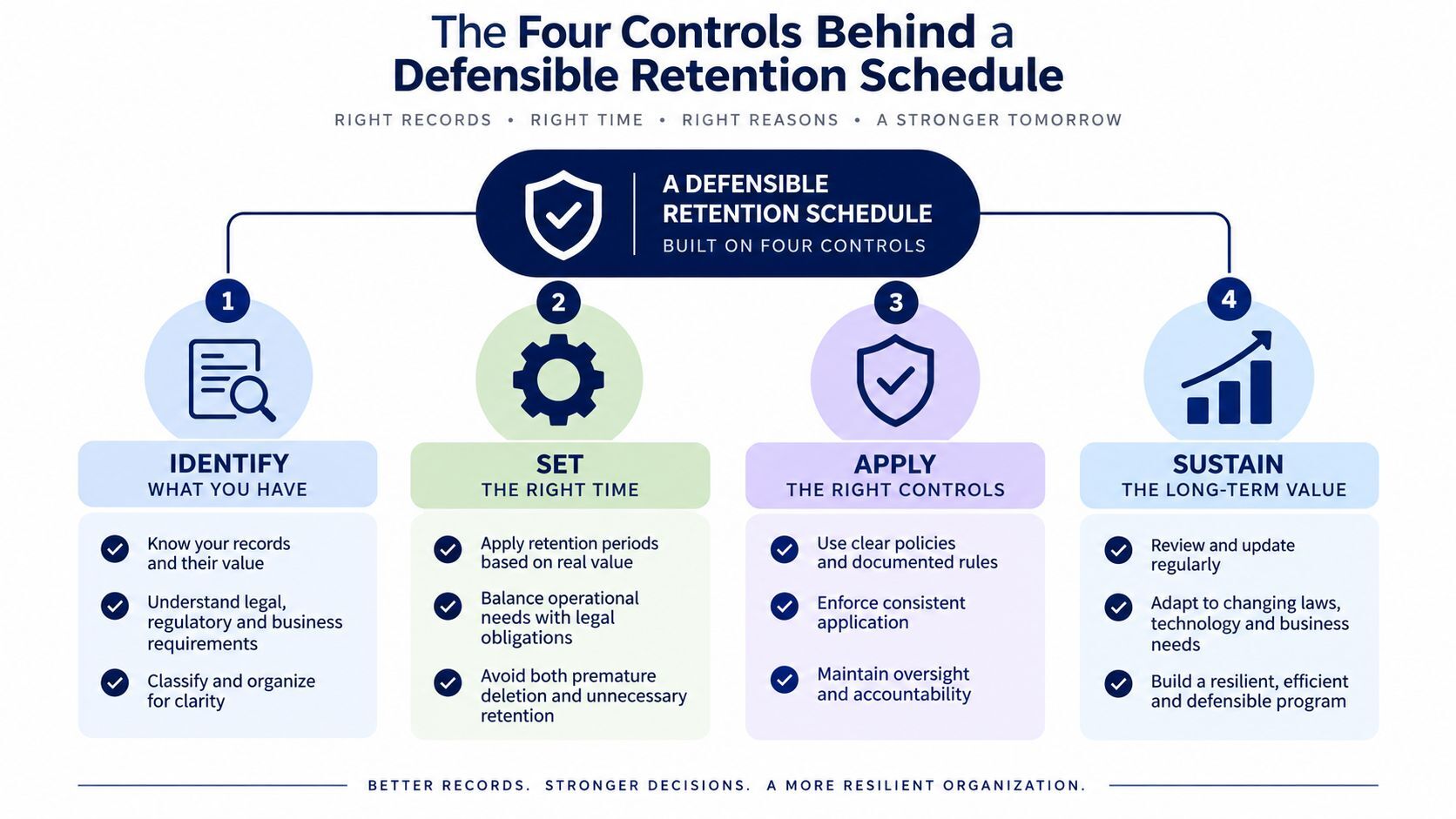
A defensible schedule identifies valuable records, sets justified periods, applies enforceable controls, and remains current over time.
1. Identify What You Have
Start with a record inventory. For each class, document:
- What the record contains
- Why the organization keeps it
- Which business process creates it
- Whether it contains personal, confidential, regulated, or security-sensitive information
- Which system is the authoritative source
- Who owns the record class
For example, "contractor access logs" is more useful than the broad label "logs." The class can include authentication events, approval records, session metadata, recorded activity, and file-transfer events while distinguishing authoritative records from temporary exports and duplicates.
2. Set the Right Retention Rule
Each record class needs a justified retention period and a clear trigger. The trigger may be:
- Creation of the record
- Completion of an access session
- Closure of an account
- End of a contract
- Resolution of an incident
- Completion of an audit
- Release of a legal hold
Event-based triggers are often easier to defend than an arbitrary calendar date because they tie retention to the record's business purpose.
3. Apply the Right Controls
A schedule becomes operational only when systems enforce it. Controls may include:
- Role-based access
- Encryption
- Tamper-evident or write-protected storage
- Automated expiry or review workflows
- Legal-hold capability
- Disposal approval
- Access and disposition logging
- Rules for backups, replicas, and exported copies
The system should prevent unauthorized deletion while allowing authorized disposition when the retention requirement ends.
4. Sustain the Program
Review the schedule when laws, contracts, business processes, technologies, or risks change. Owners should periodically confirm that:
- The record class still exists
- The stated purpose remains valid
- The retention period is still justified
- The authoritative system has not changed
- Legal holds can be applied and released
- Disposal reaches relevant copies and backups
- Evidence of disposition remains available
How to Create a Record Retention Policy
A practical policy-development process has six steps: understand the need, define scope, draft the rules, review them with stakeholders, approve and communicate the policy, and monitor its operation.
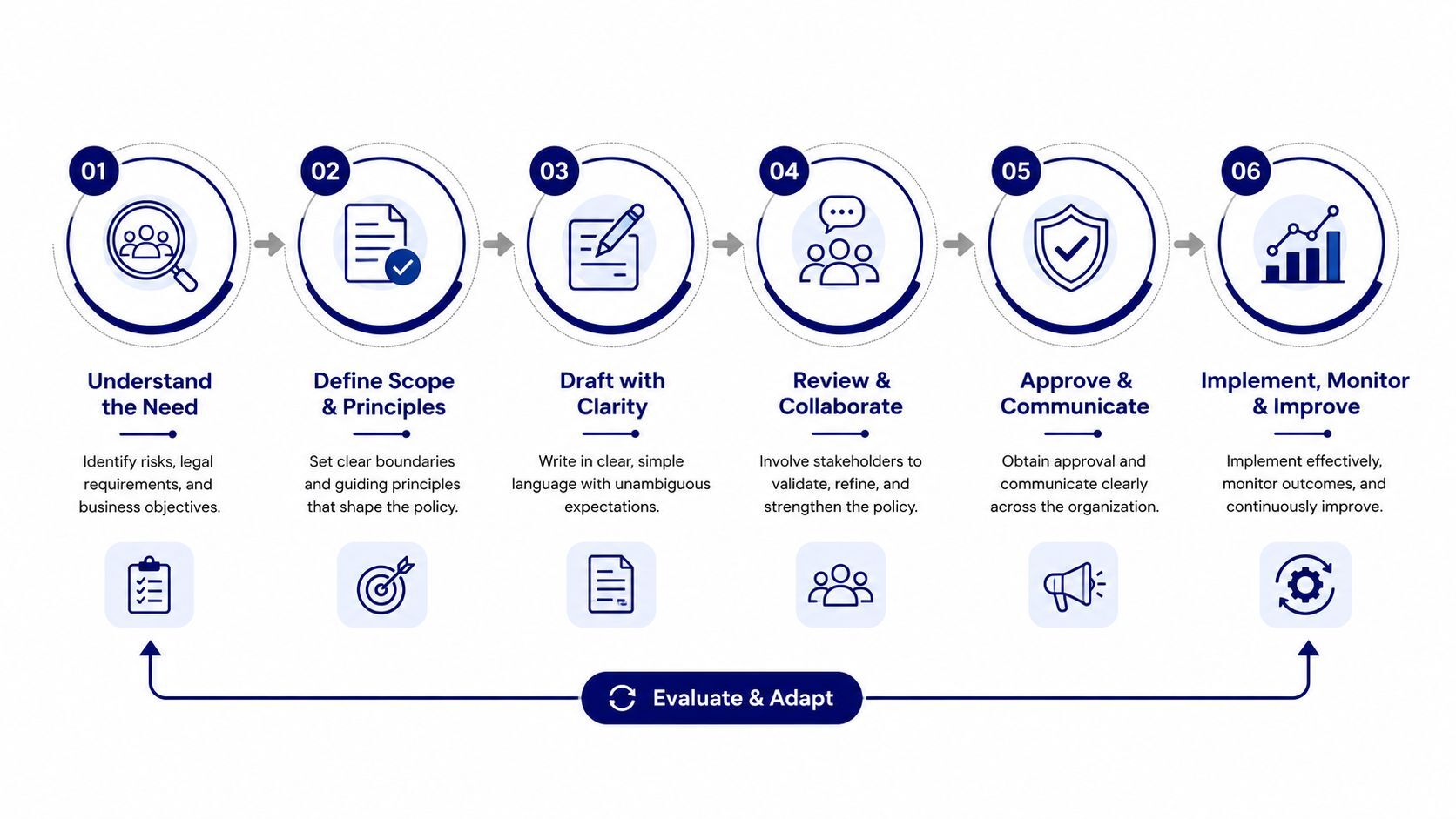
Retention policy development is a continuous governance process, not a one-time document exercise.
Step 1: Understand the Need
Identify the risks the policy must address. These may include regulatory obligations, investigations, contractual commitments, privacy requirements, operational recovery, and historical value.
Step 2: Define the Scope and Principles
State which business units, systems, locations, record formats, cloud services, and third parties are in scope. Define principles such as purpose limitation, minimum necessary retention, secure preservation, authorized access, and documented disposition.
Step 3: Build the Retention Schedule
For each record class, specify:
- Record-class name and description
- Business and legal purpose
- Owner
- System of record
- Retention trigger
- Retention period
- Security classification
- Legal-hold treatment
- Final disposition
- Required evidence of disposal
Step 4: Review with Stakeholders
Legal, privacy, compliance, security, IT, records management, and relevant business owners should review the schedule. OT and industrial environments may also require input from engineering, safety, and operations teams.
Step 5: Approve and Communicate
Assign formal approval authority, publish the effective version, train affected teams, and document exceptions. Users should know where authoritative records belong and should not create uncontrolled copies in email, personal storage, or local devices.
Step 6: Implement, Monitor, and Improve
Configure retention and hold controls in the systems that create or store records. Test deletion, retrieval, legal hold, restoration, and audit reporting. Review exceptions and update the policy when systems or obligations change.
How Should Organizations Set Retention Periods?
No universal retention period applies to every cybersecurity record. The correct period depends on the record's purpose and the requirements that apply to the organization.
Use the following order of analysis:
- Identify applicable laws and regulatory rules.
- Identify contractual, insurance, audit, and investigation requirements.
- Determine the record's operational value.
- Evaluate privacy and security risks created by continued retention.
- Define a clear trigger and documented period.
- Apply legal-hold and exception rules.
- Review and dispose of the record when the justified purpose ends.
How Major Frameworks Affect Retention Decisions
|
Framework or rule |
What it means for retention |
Important limitation |
|
ISO/IEC 27001:2022 |
Organizations manage information-security risk through an ISMS and select appropriate controls for records, logging, access, and information protection. |
It does not prescribe one universal retention period for all logs or records. |
|
NIST SP 800-171 Rev. 3 |
Requirement 03.03.03 states that audit records should be retained for a period consistent with the records retention policy. |
It applies specifically to protecting Controlled Unclassified Information in covered nonfederal systems and agreements. |
|
FINRA Rule 4511 |
FINRA members must preserve required books and records; where no other period is specified, the default is at least six years. |
Other FINRA or Exchange Act rules may specify a different period. |
|
GDPR and UK GDPR storage limitation |
Personal data should not be kept longer than necessary for its stated purpose and should be reviewed, erased, or anonymized when no longer needed. |
These rules do not provide a single retention period for every type of personal data. |
Do not copy a retention period from another organization without checking its jurisdiction, regulatory status, contracts, risk profile, and purpose for processing the information. Legal and privacy counsel should validate requirements that apply to the organization.
How Does a Legal Hold Change the Retention Schedule?
A legal hold suspends routine deletion for records that may be relevant to litigation, an investigation, a regulatory inquiry, an audit, or another protected matter.
The hold process should define:
- Who may issue a hold
- Which record classes, systems, people, and dates are covered
- How automated expiry and deletion jobs are suspended
- How custodians and system owners are notified
- How compliance with the hold is monitored
- How new records are captured while the hold remains active
- Who may release the hold
- How the normal schedule resumes after release
A hold should cover relevant exports, replicas, and backups where technically and legally required. It should also be narrow enough to avoid freezing unrelated records indefinitely.
If a record may become evidence, the hold state must override the normal disposition state.
Applying Retention to Privileged-Access Logs and Session Recordings
Privileged-access records require special care because they may document high-risk activity while also containing usernames, commands, filenames, screen content, ticket references, and other personal or confidential information.
Treat a privileged session as a record series rather than a collection of unrelated files. The record series may include:
- Authentication and MFA events
- Access requests and approvals
- Session start and end times
- Identity and target-resource details
- Commands or recorded session activity
- File-transfer events
- Policy decisions and termination events
- Related incident, maintenance, or change tickets
For each series, identify the authoritative source, the trigger that starts retention, authorized users, integrity protections, retrieval requirements, legal-hold behavior, and the treatment of exported copies.
Retention and Evidence Preservation Are Related but Different
Retention determines how long a record should remain. Evidence preservation protects a potentially relevant record and its context from loss, unauthorized change, or undocumented handling.
A log can be retained without having a documented chain of custody. A session recording can be preserved for an investigation even after its routine retention period would otherwise have ended. Organizations should connect the two processes without treating them as interchangeable.
For more detail, read Evidence Preservation in Cybersecurity: A Practical Guide for IT and OT.
How Safous Supports Retention and Audit Readiness
Safous Privileged Remote Access can help organizations create attributable records for remote administrators, contractors, and third-party vendors. Relevant capabilities include identity-based access control, session monitoring and recording, and centralized audit logs showing who accessed what, when, and from where.
Safous helps organizations control and record privileged remote access across hybrid IT and OT environments.
These records can support investigations, audits, and compliance reviews when they are placed under the organization's approved retention schedule and evidence-handling procedures.
Safous does not determine an organization's legal retention periods or replace its legal hold, evidence repository, or records-management processes. Instead, it helps create controlled access records that can become part of the broader governance program.
Learn more in the Safous Privileged Remote Access guide and Auditability in Zero Trust.
Sample Record Retention Schedule
The following structure is a starting point, not a universal legal schedule. Each organization should replace the example approach with approved requirements.
|
Record class |
Example contents |
Suggested trigger |
Retention approach |
Final disposition |
|
Access logs |
Authentication, authorization, and policy events |
Event date or account closure |
Retain for the approved security, investigation, or compliance period |
Secure deletion or approved archive |
|
Privileged-session records |
Session metadata, recordings, commands, and file-transfer events |
Session completion |
Retain according to risk, investigation, privacy, and applicable regulatory requirements |
Secure deletion after holds expire |
|
Incident records |
Case notes, evidence, approvals, and remediation records |
Incident closure |
Retain through the incident lifecycle, follow-up period, and any legal hold |
Secure deletion or archive |
|
Vendor agreements |
Contracts, amendments, approvals, and renewals |
Contract termination |
Retain for the contract term and approved post-termination period |
Secure deletion or archive |
|
Audit reports |
Internal and external audit evidence |
Audit completion |
Retain through follow-up and the applicable review cycle |
Secure deletion or archive |
Every production schedule should also name the owner, system of record, legal basis or business purpose, security classification, hold rule, and disposal approver.
A 90-Day Record Retention Implementation Plan
Days 1-30: Discover and Classify
- Inventory the highest-risk record classes.
- Identify record owners and authoritative systems.
- Map current retention settings, exports, replicas, and backups.
- Identify applicable legal, regulatory, contractual, privacy, and investigation requirements.
- Prioritize privileged-access logs, session recordings, incident records, and third-party access evidence.
Days 31-60: Define and Configure
- Approve triggers and retention periods.
- Define the legal-hold workflow.
- Assign disposition authority.
- Configure access, retention, review, and deletion controls.
- Document how backups and exported copies are treated.
- Add required logging for access, holds, and disposition.
Days 61-90: Test and Improve
- Test retrieval of a retained record.
- Test a legal hold and release.
- Verify that deletion reaches the intended systems and copies.
- Confirm that disposal evidence is generated.
- Run an audit or incident-response tabletop exercise.
- Record exceptions and assign remediation owners.
Record Retention Audit Checklist
Use this checklist to determine whether the program is executable and defensible:
- The policy clearly defines a record, a duplicate, and transitory information.
- Each record class has a named owner and system of record.
- Each schedule entry has a clear trigger and approved period.
- The policy documents legal, regulatory, contractual, privacy, and business requirements.
- Access is restricted based on the record's sensitivity.
- Integrity and retrieval requirements are defined.
- A legal hold can suspend automated deletion.
- The policy addresses exports, replicas, and backups.
- Disposal requires authorization and produces evidence.
- Exceptions have owners and expiration dates.
- The schedule is reviewed after material legal, process, or technology changes.
Frequently Asked Questions
What is a record retention policy?
A record retention policy is a documented framework that defines which organizational records must be kept, why they are kept, how long they remain, where they are stored, who controls them, and how they are securely disposed of.
What is the difference between a retention policy and a retention schedule?
The policy establishes organization-wide governance principles and responsibilities. The schedule applies those principles to individual record classes by assigning a trigger, retention period, system of record, hold rule, and disposition method.
How long should cybersecurity logs be retained?
There is no universal period. The organization should consider applicable laws and regulations, contracts, incident-detection and investigation needs, privacy obligations, log volume, and risk. Document and review the selected period.
Does a legal hold override a retention schedule?
Yes. A properly authorized legal hold suspends normal deletion for the records within its scope. Routine disposition should resume only after the hold is formally released and you evaluate any remaining retention requirement.
Should backups follow the retention policy?
Yes. The policy should explain how backup copies are protected, retrieved, held, expired, and placed beyond use. Deleting a live copy does not complete disposition if uncontrolled copies remain elsewhere.
Are privileged-session recordings personal data?
They can be. Recordings and related logs may contain usernames, screen content, commands, filenames, communications, or other identifiable information. Organizations should evaluate the applicable privacy rules and limit retention to a justified purpose.
Is retaining a log the same as preserving evidence?
No. Retention determines how long a record remains. Evidence preservation also protects integrity, provenance, context, traceability, and handling history so the record can support a reliable investigation or review.
Build Retention into the Access Lifecycle
A defensible retention program can answer seven questions for every important record: What is it? Why is it kept? Who owns it? When does the clock start? How long does it remain? What suspends deletion? How is final disposition proved?
For privileged and third-party access, design those answers into the access path before an incident occurs. Individually attributable identities, controlled access, session records, centralized audit logs, legal-hold procedures, and documented disposal give security, legal, privacy, and audit teams a shared foundation.
Explore Safous Privileged Remote Access
This article provides general information and is not legal advice. Organizations should consult qualified legal, privacy, compliance, and records-management professionals when establishing retention requirements.
References
Subscribe with Safous
Receive the latest news, events, webcasts and special offers!