
Remote access is one of the most scrutinized areas in security audits. Administrators, vendors and OT engineers routinely connect to critical systems from outside the network, and auditors want to know who connected, to what, with whose approval, and what they did during the session. Legacy tools such as VPNs and shared jump servers rarely answer those questions well.
This guide explains what remote access compliance requires, why VPN-based access makes it difficult, and how agentless privileged remote access helps organizations meet audit requirements across IT and OT environments – without disrupting operations.
What Does Remote Access Compliance Require?
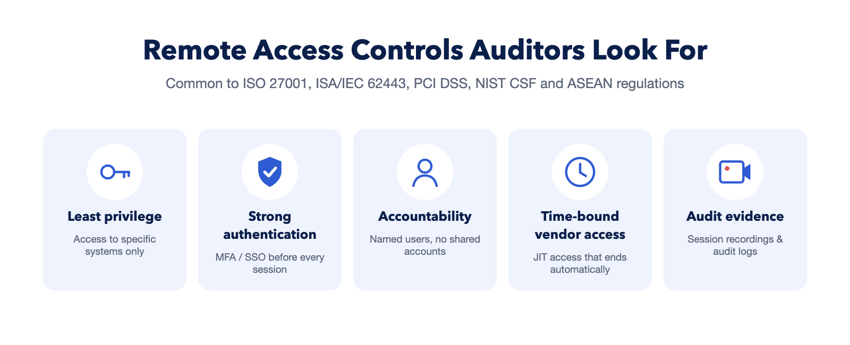
Requirements differ by framework and industry, but most share the same core controls for remote and privileged access:
- Least-privilege access: users receive only the access needed for a specific task.
- Strong authentication: multi-factor authentication for remote and privileged access.
- Individual accountability: no shared accounts; every action is attributable to a person.
- Approval and time limits: third-party access is approved and removed when no longer needed.
- Monitoring and evidence: logs and session records that can be produced for audits and investigations.
These controls appear in frameworks such as ISO 27001, NIST SP 800-171, NIST CSF, CIS Controls, PCI DSS and HIPAA, in OT standards such as ISA/IEC 62443, and in regional regulations across ASEAN, including personal data protection laws.
Why VPNs Make Compliance Harder
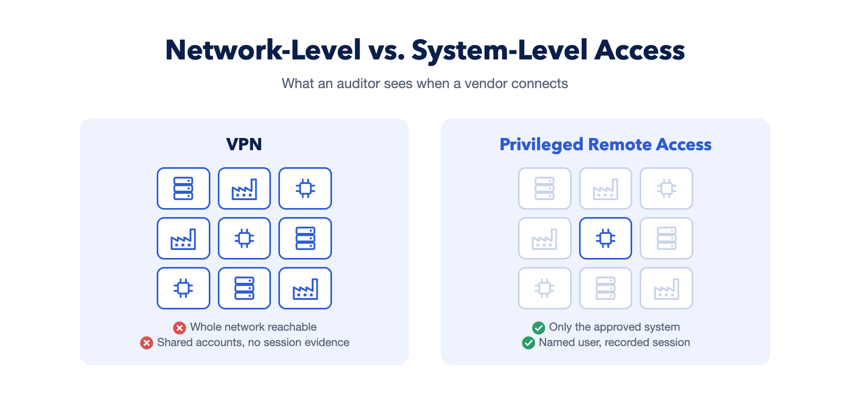
VPNs were designed for connectivity, not for controlling privileged activity. Once connected, a VPN user is placed on the network rather than on a specific system. That creates several audit gaps:
- Over-broad access: users can reach systems beyond their task, which conflicts with least-privilege requirements.
- Weak attribution: vendors often share VPN or system accounts, making it hard to prove who did what.
- No session evidence: VPN logs show connections, not the actions taken on critical systems.
- Standing access: vendor VPN accounts frequently remain active long after the work is finished.
Non-Disruptive Compliance for OT and Industrial Networks
In OT environments, compliance controls must not interrupt production. Installing agents on PLCs, HMIs or industrial servers is often impossible or unsupported by equipment vendors, and opening inbound firewall ports to let vendors in increases exposure.
Agentless privileged remote access addresses both constraints. Nothing is installed on industrial systems, gateways connect outbound without inbound firewall ports, and vendors reach only the specific assets they maintain during an approved window. Every session can be recorded, giving operators evidence for ISA/IEC 62443 and internal audits without changing the control systems themselves.
How Privileged Remote Access Produces Audit Evidence
| Compliance requirement | How privileged remote access addresses it |
|---|---|
| Least privilege | Access to specific systems only, defined by role and policy |
| Strong authentication | MFA and SSO enforced before every session |
| Individual accountability | Named users instead of shared accounts |
| Third-party access control | Just-in-time, time-bound access that ends automatically |
| Monitoring and evidence | Session recordings and centralized audit logs |
Best Practices for Remote Access Compliance
- Inventory remote access paths. Identify every VPN, jump server, remote desktop tool and vendor connection into IT and OT networks.
- Eliminate shared accounts. Require named identities with MFA for every administrator and vendor.
- Replace network-level access with system-level access. Connect users to specific systems, not subnets.
- Make vendor access time-bound. Grant access for a defined window and revoke it automatically.
- Record privileged sessions. Keep recordings and logs according to your retention requirements.
- Review access regularly. Use centralized reports to review who has access and how it was used.
How Safous Supports Remote Access Compliance
Safous provides agentless privileged remote access for IT, OT and third-party users, with the controls auditors look for:
- Identity-based, least-privilege access to specific systems, with MFA and SSO
- Just-in-time, time-bound access for vendors and contractors
- Privileged session monitoring, recording and detailed audit trails
- Browser-based access with no agents and no inbound firewall ports
See framework-specific checklists on our Regulatory Compliance page, or read the Privileged Remote Access Guide.
Frequently Asked Questions
What is remote access compliance?
Remote access compliance means controlling and evidencing remote connections to systems in line with security frameworks and regulations – typically through least-privilege access, MFA, individual accountability, time-bound vendor access, and logging or session recording.
Is a VPN enough for compliance?
Usually not on its own. VPNs provide network-level connectivity but rarely restrict users to specific systems or record what they do, which leaves gaps for least-privilege and audit evidence requirements.
How do you make vendor remote access compliant?
Give each vendor a named identity with MFA, limit access to the specific systems they support, grant access only for a defined time window, and record their sessions.
Can OT remote access be compliant without installing agents?
Yes. Agentless privileged remote access controls and records OT sessions without installing software on industrial systems or opening inbound firewall ports.
Need to close remote access gaps before your next audit? Get started with Safous.
Subscribe with Safous
Receive the latest news, events, webcasts and special offers!