

Access governance is the process of defining, approving, reviewing, and removing access to an organization’s systems and data. It establishes who should have access, what they may access, why they need it, and when that access should end.
For third-party vendors, those decisions need additional context. A vendor may be authorized to support a system without being authorized to access it at any time, from any device, or for any purpose.
For example, an equipment manufacturer troubleshooting a production workstation needs access for a specific maintenance task. That is a different relationship from an employee using business applications every day.
Secure third-party access therefore requires governance that connects the vendor’s identity to an approved task, a specific resource, a limited access window, and observable activity. The goal is to help external specialists complete their work while keeping the organization in control of its systems.
What Does Access Governance Cover?
Access governance establishes accountability for access decisions throughout their lifecycle. It typically includes:
- Access ownership: identifying who approves and reviews access.
- Roles and entitlements: defining which resources and permissions each identity needs.
- Provisioning: granting approved access through a controlled process.
- Access certification: periodically checking whether permissions remain appropriate.
- Revocation: removing access when the business need ends.
- Evidence: retaining records that explain access decisions and support investigation.
These responsibilities apply to employees, contractors, vendors, and non-human identities. However, the information needed to govern each group can differ.
For employees, access decisions often draw on HR records, job roles, and managed devices. For vendors, the organization may also need to consider the contract, the individual technician, the internal sponsor, the support ticket, and the maintenance window.
Access Governance, IAM, and IGA: What Is the Difference?
Identity and access management (IAM) provides capabilities such as identity administration, authentication, and access enforcement.
Identity governance and administration (IGA) supports governance activities such as access requests, provisioning workflows, entitlement reviews, and separation-of-duties controls.
Access governance is the wider responsibility for deciding whether access is appropriate and ensuring those decisions remain accountable. Technology supports that responsibility, but business owners still need to define the purpose, scope, and conditions of access.
For more on the permissions layer, see What Is Entitlement Management? Lifecycle, IGA, CIEM and RPAM.
Why Is Third-Party Access Different from Employee Access?
Third-party access often depends on an external business relationship and a specific task, rather than an ongoing employment role. Governance must account for that difference.
Vendors are not inherently less trustworthy than employees. The challenge is that the organization may have less visibility into their personnel changes, devices, and internal security processes.
| Governance consideration | Typical employee access | Third-party access requirements |
|---|---|---|
| Identity ownership | Usually connected to HR and an internal manager | Requires a named external user and an accountable internal sponsor |
| Business purpose | Often based on an ongoing job role | Often tied to a contract, support request, or maintenance task |
| Device visibility | May involve organization-managed endpoints | May involve vendor-managed or otherwise unmanaged devices |
| Access scope | Covers resources needed for continuing responsibilities | Should be limited to the resources and privileges needed for the approved work |
| Access duration | Changes with employment and role changes | Needs explicit start and end conditions, including expiry between tasks where appropriate |
| Oversight | Depends on application and activity risk | Sensitive support sessions may require monitoring, supervision, and recording |
| Revocation trigger | HR events and internal role changes | Also includes task completion, vendor staff changes, contract changes, and sponsor withdrawal |
These are common patterns, not universal rules. Employees can use unmanaged devices, and some vendors provide long-term services. Governance should follow the actual access context.
The weakness appears when a vendor is simply added to an employee access group and inherits permissions designed for a continuing internal role. A valid account then substitutes for a current business justification.
For vendor access, an approved identity is the starting point. Each sensitive access session should also have a clear purpose, defined scope, and appropriate end condition.
The Four Building Blocks of Access Governance
An effective governance program connects four activities: identify, control, monitor, and review. Roles, entitlements, provisioning, and certification support these activities.
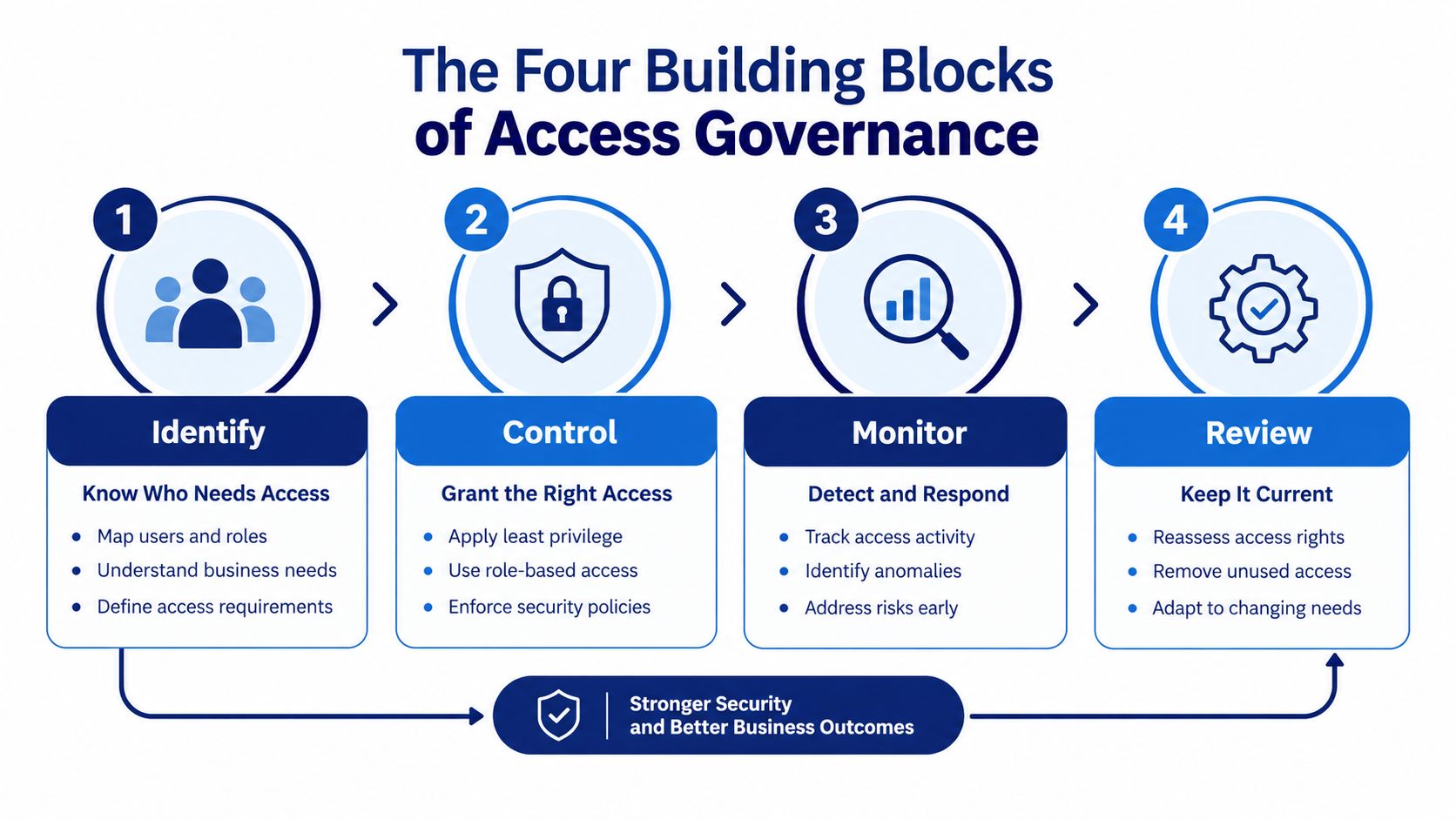
1. Identify Who Needs Access and Why
Identify the person requesting access, the organization they represent, the internal owner, and the business need.
A generic “vendor support” account provides limited accountability. Where systems require shared target accounts, the access process should still identify the individual using them.
For third parties, the request should explain which application or asset is needed and what work is authorized. Being employed by an approved supplier does not automatically justify access to every system that supplier supports.
2. Control the Scope and Conditions of Access
Translate the business need into specific permissions.
A role can provide a useful starting point, but it should not grant more access than the task requires. Separate read-only troubleshooting from administrative changes, and define access windows where work is temporary.
Provisioning should implement those conditions. For intermittent vendor work, just-in-time access can reduce the need for permissions that remain available between support sessions.
3. Monitor How Access Is Used
Approval establishes what should happen. Monitoring helps establish what actually happened.
For sensitive vendor sessions, useful evidence can include the individual’s identity, target resource, start and end times, approval reference, and relevant activity records. Session recording can provide additional visibility for supported access methods.
The depth of monitoring should reflect the task's risk and the target system's capabilities. Recording every interaction is not a universal requirement for access governance.
4. Review and Remove Access
Review whether access remains justified, whether its scope is appropriate, and whether the controls worked as intended.
For vendors, review triggers should include completed work, personnel changes, contract changes, and changes to the internal sponsor. Scheduled certification remains useful, but temporary access should not depend on the next review cycle to expire.
Entitlement Governance and Session Governance Work Together
Entitlement governance decides what access an identity is eligible to receive. Session governance controls a particular instance of that access.
Consider a vendor technician authorized to maintain a server:
- Entitlement governance establishes that the technician may support that server under an approved agreement.
- Session governance checks whether the current maintenance request is authorized, applies the appropriate access window, and provides oversight during the work.
Both layers matter. An approved entitlement does not establish that every future session is appropriate. A recorded session does not establish that the underlying permission was justified.
This distinction is especially useful for vendor access because eligibility can last longer than the immediate need to connect. A support contract may remain active for a year while individual maintenance sessions last only a few hours.
Why Access Scope Matters Across Connected Environments
Access governance becomes more challenging when external specialists support systems across cloud, on-premises, IT, and OT environments. Permissions that appear narrow in one system may provide a route to additional resources.
IBM’s 2025 research provides context for the potential financial impact of breaches across these environments.
Table 1. Selected Average Data Breach Costs Reported by IBM in 2025
| Breach category | Average breach cost |
|---|---|
| Breaches involving multiple environments | USD 5.05 million |
| On-premises data breaches | USD 4.01 million |
| Supply-chain compromise | USD 4.91 million |
| Global average | USD 4.44 million |
Sources: IBM’s analysis of the Cost of a Data Breach Report 2025 and attack vector overview.
These figures describe different breach categories. They are not estimates of losses caused specifically by weak vendor access governance, and supply-chain compromise includes risks beyond interactive vendor access.
For access governance, the practical implication is to examine what an external identity can reach across connected systems. A technician approved to service one application should not inherit unnecessary access to the surrounding environment.
Why Periodic Access Reviews Alone Are Not Enough
Periodic reviews validate permissions at a point in time. They cannot, by themselves, enforce the conditions of every vendor session between reviews.
A quarterly review might confirm that a supplier still supports a production system. It may not establish whether a technician needs access today, whether the current task requires administrative rights, or whether yesterday’s maintenance access has ended.
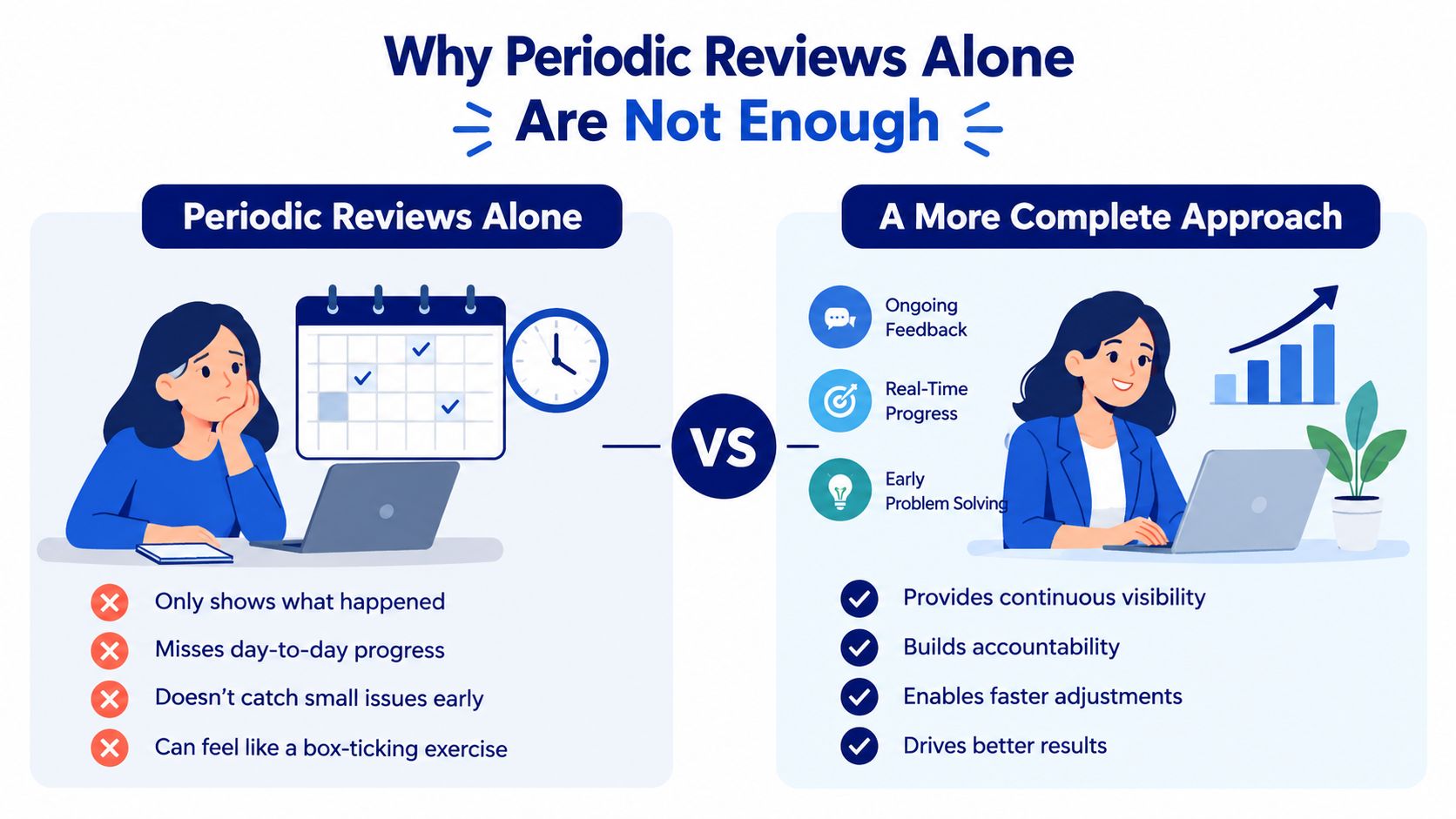
Periodic certification should therefore work alongside:
- Event-driven reviews when vendor personnel, contracts, or responsibilities change.
- Explicit expiry for temporary access.
- Approval linked to sensitive tasks or maintenance windows.
- Monitoring that helps owners compare approved work with actual activity.
- A defined process for revoking permissions and ending active sessions.
A completed review is useful evidence that a governance step occurred. Its value increases when the organization can also demonstrate that unnecessary access was removed and session conditions were enforced.
What Does Third-Party Access Governance Look Like in IT and OT?
Consider an equipment vendor troubleshooting a programmable logic controller (PLC) engineering workstation.
The vendor has an active support agreement. However, the immediate requirement is to diagnose a fault on one workstation during an approved maintenance window.
A governed access process should connect four checkpoints:
- Verify the individual. Establish who is connecting and apply the required authentication controls, including MFA where supported by the access solution.
- Confirm the task and scope. Link the request to an accountable owner, an approved purpose, and the specific workstation or application.
- Oversee the session. Apply appropriate monitoring and recording for the supported access method, with a way to intervene if required.
- End access appropriately. Expire the temporary authorization and terminate or revoke access according to policy.
In OT environments, these controls must also account for availability and operational safety. Ending access during a critical maintenance action may require coordination with the system owner.
The objective is to make vendor access bounded and accountable while enabling necessary support work. For more on resource-level permissions, see What Is Fine-Grained Access Control? A Guide for Hybrid IT and OT.
How Zero Trust and Privileged Remote Access Support Governance
Zero Trust provides principles for enforcing access decisions without assuming that network location makes an identity trustworthy.
NIST SP 800-207 describes a resource-focused approach in which authentication and authorization occur before a session to an enterprise resource is established. It rejects implicit trust based solely on location or asset ownership.
For third-party access, that means a successful login or network connection should not automatically authorize broad access to applications and assets.
Privileged Remote Access (PRA) capabilities can help enforce governance requirements on sensitive vendor access paths. Depending on the solution and configuration, these can include resource-specific access, session supervision, recording, and termination.
IGA, IAM, PAM, ZTNA, and SASE can contribute to the same architecture. Their relevance depends on the organization’s requirements and the capabilities deployed. The governance question remains consistent: Can the organization connect each vendor’s access to an approved purpose, enforce its limits, and demonstrate what happened?
How Safous Supports Secure Third-Party Access
Safous Privileged Remote Access supports policy-based access to IT and OT applications, integrated MFA and credential vaulting, and the ability to record, supervise, and terminate privileged sessions.
Safous also supports agentless access management for unmanaged users and devices, helping organizations apply controls to third-party access.
These capabilities support the enforcement layer of access governance. Business owners still define which vendor tasks are authorized, who approves them, and what access conditions apply.
How Can You Measure Third-Party Access Governance?
Measure both the quality of access decisions and the effectiveness of their enforcement.
Useful indicators include:
- Ownership coverage: the proportion of vendor identities with a current internal sponsor.
- Purpose traceability: the proportion of sensitive sessions linked to an approved task or business justification.
- Temporary access coverage: the proportion of temporary permissions with explicit expiry.
- Standing access exposure: permissions that remain available between vendor tasks without a documented need.
- Revocation performance: the time taken to remove authorization, and separately to end active sessions, after a defined trigger.
- Session evidence coverage: the proportion of high-risk sessions with the required logs or recordings.
Set targets according to risk, access method, and operational requirements. Review completion rates remain useful, but assess them alongside evidence that access is scoped, observable, and removed when no longer needed.
Frequently Asked Questions About Access Governance
What Is Access Governance in Cybersecurity?
Access governance defines who should have access to systems and data, why that access is justified, and when to remove it. It includes ownership, approval, entitlement reviews, and evidence that supports accountability.
Why Does Vendor Access Need a Different Governance Model?
Vendor access often involves external personnel, devices outside the customer’s management, and specific support tasks. Governance must account for these conditions through internal sponsorship, task-based authorization, appropriate oversight, and clear expiry or revocation triggers.
Is MFA Enough to Govern Third-Party Access?
MFA strengthens authentication. It does not decide which resources a vendor may access, why the access is needed, how long it should last, or whether activity stays within the approved scope. Those decisions require authorization and governance controls.
Does Every Vendor Session Need to Be Recorded?
Recording requirements should reflect the system's sensitivity, the task, applicable obligations, and the access method. High-risk administrative sessions may warrant recording and supervision, while other access may be governed through scoped permissions and activity logs.
Do Session Controls Replace Periodic Access Reviews?
Session controls and periodic reviews serve different purposes. Reviews validate ongoing eligibility and permissions; session controls enforce conditions for specific access events. Effective third-party access governance connects both.
Build Governance Around the Vendor’s Task
Access governance principles apply to employees and third parties alike. Their implementation should reflect how each group works.
For vendors, the key is to connect identity, business purpose, resource scope, session oversight, and access expiry. That connection helps organizations move from approving an external account to governing the work performed through it.
Subscribe with Safous
Receive the latest news, events, webcasts and special offers!
Share this
Why Human-Approved Access Matters for AI-Automated Operations

Why Human-Approved Access Matters for AI-Automated Operations
Nov 26, 2025
5
min read
How Zero Trust Access Enhances Industrial Secure Remote Access

How Zero Trust Access Enhances Industrial Secure Remote Access
Mar 30, 2024
4
min read
IAM, ZTA, and PAM: How Identity and Access Management Fits into Security

IAM, ZTA, and PAM: How Identity and Access Management Fits into Security
Jan 07, 2025
4
min read