
If you’re on the hunt for modern cybersecurity tools to protect your business network, you’ve likely come across several security options. While there isn’t a one-size-fits-all solution, many organizations find success combining zero trust network access (ZTNA) and privileged access management (PAM) to safeguard their critical assets.
We’ve discussed how ZTNA is evolving before, but what does PAM do? Both ZTNA and PAM provide organizations with advanced security measures, but they do so in different ways. This blog will explore the differences between these two approaches to help you decide if you need both for your business.
What Are the Differences Between ZTNA vs. PAM?
Before we can discuss why PAM is so important for network security, we have to take a look at privileges.
When it comes to IT, privileges are defined as the authority an account or process has within a computing system or network. Since privileges provide access to restricted information and administrative functions, such as adding or deleting users and configuring system settings, they are usually only available to users with privileged accounts.
A privileged account is any account with higher privileges than non-privileged accounts. These are often administrator or superuser accounts, which allow the user to install software, change local configurations and settings, and more. Because privileged accounts can access confidential data and secure environments, additional security measures are needed to protect them.
That’s where privileged access management comes in. PAM is a security model that aims to prevent unauthorized access to privileged accounts. Since PAM manages and monitors privileged access to sensitive resources – servers, databases, and critical applications – it can ensure privileged access is only granted to authorized users and isn’t being misused.
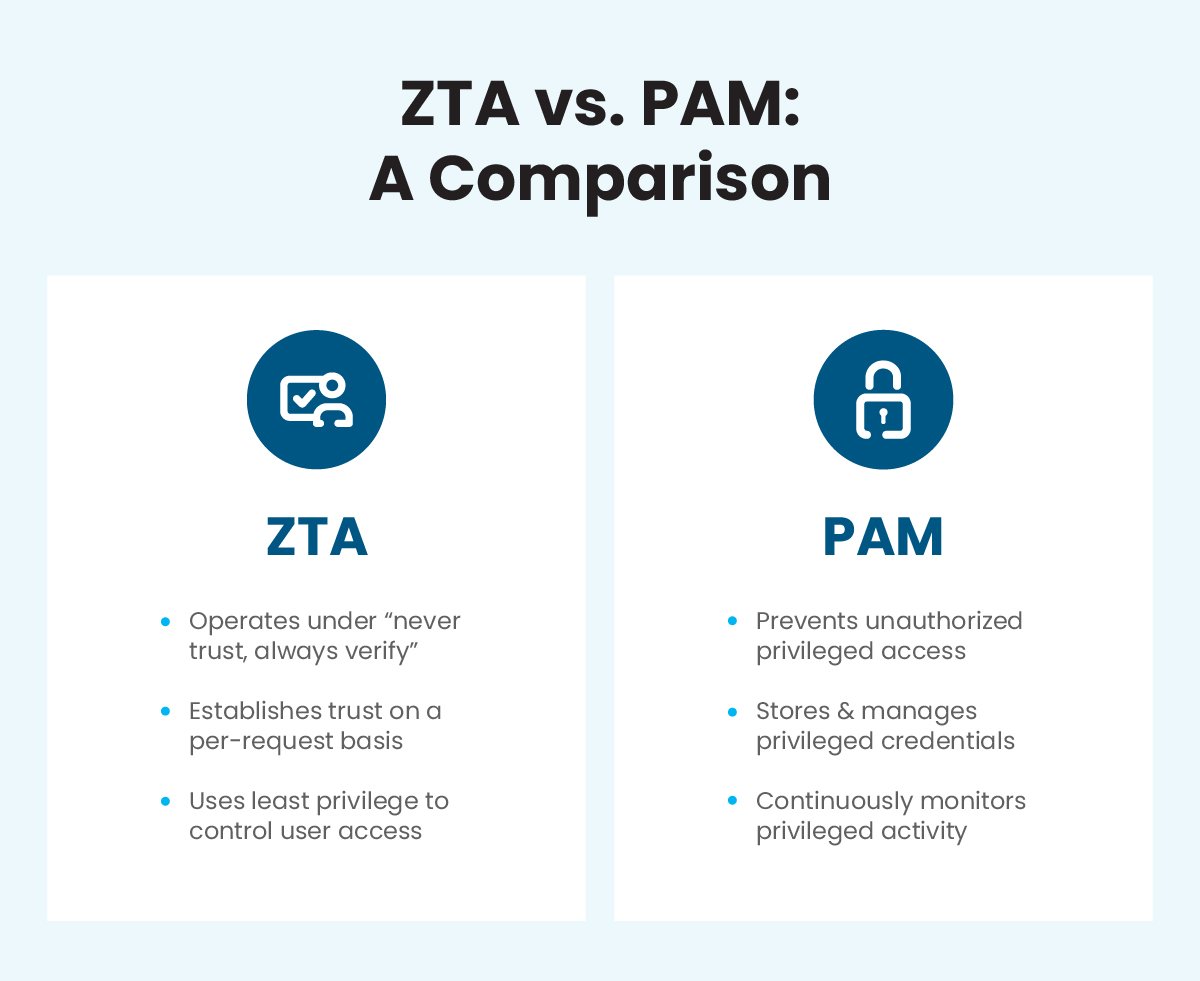
Zero trust network access also safeguards access, but operates under different concepts. ZTNA applies zero trust principles to connectivity: no user, device, or application is trusted by default, and every request is verified based on identity and context. Instead of placing users on the network like a VPN, ZTNA connects them only to the specific applications they are authorized to use.
How Does PAM Differ From the Principle of Least Privilege?
The principle of least privilege is a security concept that says users, applications, or processes should only be granted the minimum privileges necessary to perform their job functions or required tasks. By enforcing this principle across your IT environment, you can define both the scope and duration of privileged access, then automatically revoke access when the user completes the privileged activity.
PAM employs least privilege access to provide the management and oversight needed to mitigate the risks posed by privileged accounts. However, it’s not the only technology businesses can use to enforce the principle of least privilege – ZTNA applies it at the connection level as well.
Why Should Businesses Use Both ZTNA and PAM?
The zero trust concept of “never trust, always verify” is about controlling access – and with a whopping 80% of data breaches stemming from compromised privileged account credentials,1 it’s clear that unnecessary privileges are the riskiest type of access.
In most cases, cybercriminals try to capture privileged account credentials to gain access to the rest of a business network and the data within it. Once they breach a privileged account, they can move throughout the network without leaving a trace or triggering any alarms. PAM reduces this risk by protecting privileged credentials and monitoring how they are used.
While ZTNA uses the principle of least privilege to control what users can reach once authorized, adding PAM functions can enable businesses to:
- More easily enforce authentication and authorization policies for privileged accounts.
- Continuously monitor access and take immediate action whenever a threat is detected.
- Remediate risky behavior by suspending or terminating privileged access automatically.
- Maintain a complete audit record to satisfy compliance requirements and aid remediation.
- Keep track of all remote and privileged account access and activities in one place.
Frequently Asked Questions
Can ZTNA replace PAM?
Not entirely. ZTNA controls who can connect to which application, while PAM controls and records what privileged users do once connected. Organizations with administrators, service accounts, or third-party vendors typically need both.
Is ZTNA the same as zero trust architecture (ZTA)?
No. Zero trust architecture is the overall security strategy. ZTNA is one technology that implements it, focused on secure access to applications and systems.
Keep Your Business Network Secure With Safous
Network security is constantly evolving – especially as more organizations embrace the cloud and hybrid working models. Luckily, there are many cybersecurity tools to help ensure your network and critical data are always secure – without compromising on fast, reliable access for your employees.
Safous Privileged Remote Access applies zero trust principles to privileged remote sessions – identity verification, least-privilege access, and session recording – so you get the core benefits of both approaches for administrator and vendor access, with integrated multi-factor authentication (MFA) and single sign-on (SSO).
Trust Safous for:
- Identity-based, least-privilege access to specific systems
- Just-in-time access for vendors and contractors
- Privileged session monitoring and recording
- Detailed audit trails for compliance
- Quick and easy onboarding
- No additional software, plug-ins, or specific OS required
If you’re ready to strengthen your security posture, Safous is here to help. Request a demo today to learn how Safous Privileged Remote Access can eliminate network vulnerabilities, prevent breaches, and more.
Sources:
Subscribe with Safous
Receive the latest news, events, webcasts and special offers!
Share this
How Zero Trust and Remote PAM Fast-Track ISO/IEC 27001 Compliance

How Zero Trust and Remote PAM Fast-Track ISO/IEC 27001 Compliance
Sep 12, 2025
4
min read
What Is Least Privilege Access? How It Works With ZTNA and PAM

What Is Least Privilege Access? How It Works With ZTNA and PAM
Oct 18, 2022
2
min read
How To Choose the Right PAM Solution for Your Business
How To Choose the Right PAM Solution for Your Business
Apr 17, 2023
3
min read