













IEC 62443 remote access requirements define how operators of industrial automation and control systems (IACS) should control connections from outside a control zone, including engineers working from home, OEM maintenance vendors and remote operations centers. For plant operators in Singapore, Malaysia, Thailand, Indonesia, Vietnam, the Philippines and Japan, the standard is often the reference that customers, insurers and auditors use to judge OT remote access. This guide maps remote access controls to the specific IEC 62443 requirements they address and gives a step-by-step method to build the evidence.
What does IEC 62443 require for remote access?
IEC 62443 does not contain one remote access clause; remote access is treated as a conduit into a security zone, and the controls on that conduit must meet the zone's target security level. The requirements that apply come from several parts of the series.
- IEC 62443-2-1 sets the security program requirements for IACS asset owners, including how access is governed.
- IEC 62443-2-4 sets security program requirements for IACS service providers, such as system integrators and maintenance vendors.
- IEC 62443-3-2 defines the risk assessment that divides the system into zones and conduits and assigns a target security level (SL-T) to each.
- IEC 62443-3-3 lists the system security requirements (SRs) and security levels that the implemented controls must meet.
- IEC 62443-4-2 sets technical security requirements for individual IACS components.
The official overview of the series is published by ISA: ISA/IEC 62443 Series of Standards. For how zones and conduits shape OT remote access architecture, see Designing OT Secure Remote Access Architecture.
Which IEC 62443-3-3 requirements apply to remote access?
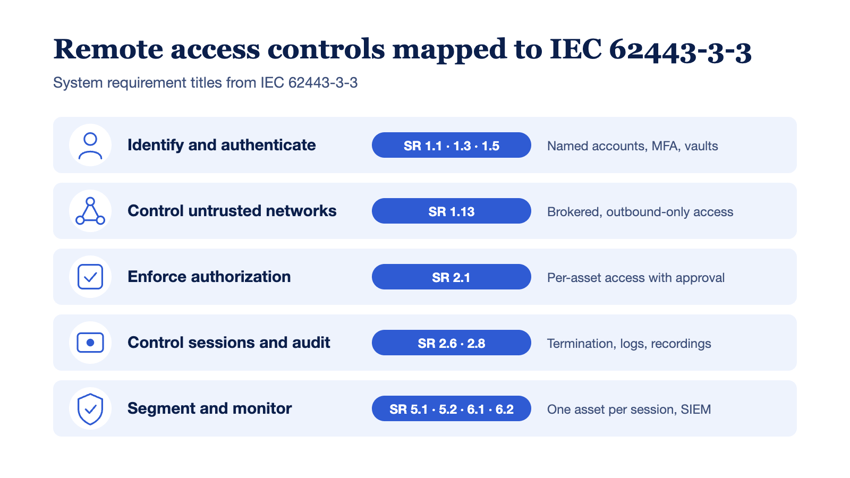
The IEC 62443-3-3 system requirements that most directly apply to remote access cover identification and authentication, authorization, remote sessions, audit and network segmentation. The table maps each requirement to a remote access control and the evidence an assessor can review. Requirement titles follow the IEC 62443-3-3 table of contents; check the full requirement text and requirement enhancements for your target security level.
How do security levels change remote access controls?
Security levels decide how strong each remote access control must be: the higher the target security level of a zone, the more requirement enhancements apply to the conduit that reaches it. IEC 62443 defines security levels from SL 1 to SL 4, based on the capability of the attacker the zone must withstand.
In practice, the risk assessment under IEC 62443-3-2 assigns a target security level (SL-T) to each zone, and the achieved security level (SL-A) of the implemented controls is compared with it. A remote access path into a safety-related or high-consequence zone therefore needs stronger controls than one into a monitoring zone, for example multi-factor authentication for every session, approval per session and recording of all privileged actions.
How should vendor remote access be handled under IEC 62443?
Vendor remote access should be controlled by the asset owner, with each vendor engineer authenticated individually, approved per session and limited to the assets in the work order. IEC 62443-2-4 sets security program requirements for service providers, but the asset owner remains responsible for the conduit into its own zones.
This matters in ASEAN and Japan, where OEMs and maintenance contractors often support plants, utilities and factories across several countries. Common gaps are shared vendor accounts, always-on VPN tunnels and cellular modems installed by the vendor. Replacing them with brokered, recorded sessions gives the operator one record of who accessed which controller and what they did. See third-party access for the vendor workflow.
How to map remote access controls to IEC 62443: step by step
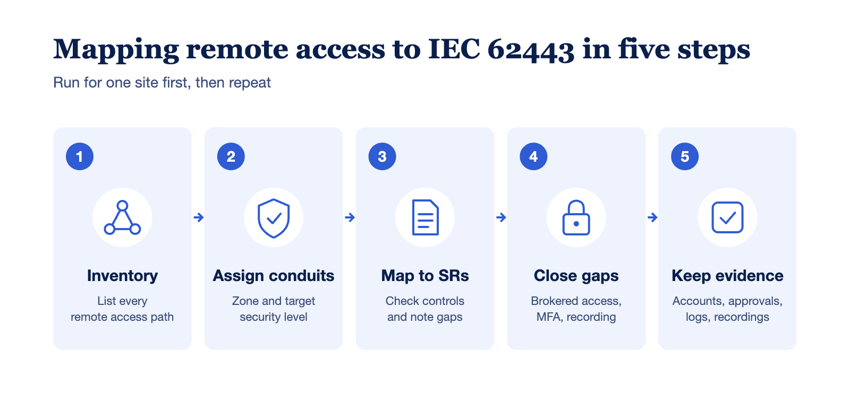
Mapping remote access to IEC 62443 starts with the zone model and ends with evidence for each system requirement. The following five steps can be run for one site first and then repeated.
- Inventory remote access paths. List every way users reach the OT network from outside: VPNs, jump hosts, remote desktop tools, modems and vendor gateways.
- Assign each path to a conduit. Record which zone each path enters and the target security level of that zone from the risk assessment.
- Map controls to system requirements. For each conduit, check the controls against the IEC 62443-3-3 requirements in the table above and note the gaps.
- Close gaps with brokered access. Replace network-level access with access per application or asset, with MFA, approval, credential injection and recording.
- Collect evidence. Keep account lists, approval records, session recordings and logs in a form an assessor can review.
Safous provides an ISA/IEC 62443 compliance checklist that can be used alongside these steps.
How Safous supports IEC 62443 remote access controls
Safous provides controls and audit evidence that support the IEC 62443-3-3 requirements for the remote access conduit; it does not by itself make a system conformant. Safous Privileged Remote Access brokers each session to a single application or asset instead of placing the user on the network.
- Identification and authentication: built-in IdP or integration with LDAP/AD, SAML, OIDC and RADIUS, with MFA for every user.
- Authorization: RBAC and ABAC, just-in-time access and up to 5-level access approvals.
- Untrusted networks: the Safous AppGateway connects out over TLS, so no inbound firewall ports are opened; access from VPN, proxy, Tor and hosting sources can be blocked.
- Sessions and audit: live monitoring and termination, session recording for RDP, SSH, VNC and Telnet, command-level logging and SIEM integration.
- Credentials: vaults, credential injection and password rotation.
- Air-gapped OT: private PoP and isolated AppGateway options.
Credentials, logs and recordings stay in the customer environment. For OT deployments, see industrial secure remote access; for other frameworks, see regulatory compliance and remote access compliance.
Frequently asked questions
Does IEC 62443 have a single remote access requirement?
No. IEC 62443 has no single remote access clause. Remote access requirements are spread across the standard: IEC 62443-3-3 sets system requirements such as SR 1.13 (access via untrusted networks) and SR 2.6 (remote session termination), IEC 62443-2-4 covers service providers that maintain the system, and IEC 62443-3-2 defines the zones, conduits and target security levels that decide how strict the controls must be.
Is a VPN enough to meet IEC 62443 remote access requirements?
A VPN alone usually covers only part of the requirements. It encrypts the connection but typically places the user on a network segment, so the operator still needs per-user authentication, authorization per asset, session termination, auditable events and monitoring to address the related IEC 62443-3-3 system requirements for the remote access conduit.
How do third-party maintenance vendors fit into IEC 62443?
IEC 62443-2-4 sets security program requirements for IACS service providers such as integrators and maintenance vendors. The asset owner still controls how vendors connect, so vendor remote access should use named accounts, approval before each session, access limited to the assets in the work order, and session recording that the asset owner keeps.
Can a product make an OT system IEC 62443 compliant?
No. IEC 62443 conformance applies to a security program, a system or a component and is assessed against the relevant part of the standard. A remote access product can provide controls and audit evidence that support specific system requirements, but the asset owner must define zones, conduits and target security levels and verify that the implemented controls meet them.
Map your OT remote access to IEC 62443. Get started with Safous to see brokered, recorded remote access for your plants and vendors.
Subscribe with Safous
Receive the latest news, events, webcasts and special offers!