








A privileged remote access evaluation decides how administrators, third-party vendors and OT engineers will reach your most critical systems, and what evidence you will have afterwards. Product lists rarely help, because the right choice depends on what you are protecting, who connects and which regulators or customers audit you. This checklist gives IT, OT and audit teams a shared set of criteria and vendor questions, with notes for organizations in ASEAN and Japan.
What is a privileged remote access evaluation?
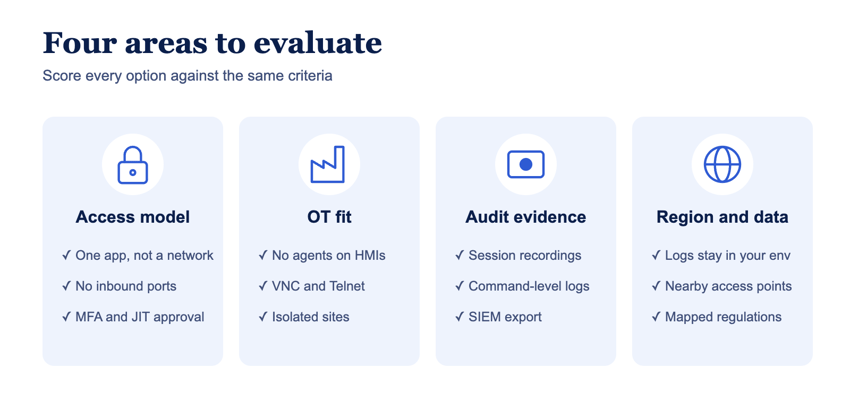
A privileged remote access evaluation is a structured comparison of how candidate solutions control, broker and record privileged sessions to critical systems. It tests four areas: the access model, fit for OT and isolated sites, audit evidence, and regional and deployment requirements. For background on how privileged remote access works and how it differs from VPNs, ZTNA and PAM, see our privileged remote access guide.
It differs from a general PAM evaluation, which centers on vaulting and endpoint privilege. Here the focus is the remote session itself: who can open it, to which system, under which approval, and what record it leaves. If you are still deciding whether to keep jump servers or VPNs, read Jump Server vs Privileged Remote Access first.
Start with who connects and what they reach
Define user groups and target systems before comparing products, because each group needs a different control set.
Privileged remote access evaluation checklist
Use the criteria below as the core of your requirements document; the last column shows how Safous Privileged Remote Access addresses each one, which you should verify in your own proof of concept.
OT criteria: avoid disruption first
In OT, the first criterion is that remote access must not change the control system: no agents on controllers or HMIs, no new inbound paths into the control network, and no forced upgrades of legacy operating systems.
Ask how each option separates users, assets, privileges and session scope, and how it supports vendor maintenance windows. Check support for VNC and Telnet on older equipment, supervised sessions for high-risk changes, and operation at sites with limited or no internet connectivity. Usability matters too: if engineers find the secure path slower than the old workaround, the workaround returns. Our article on OT security and the industrial secure remote access page cover the OT context in more detail.
Audit criteria: evidence you can hand over
A solution passes the audit test when it produces, without manual work, a record of who requested access, who approved it, when it started and ended, and what was done during the session.
Ask for a sample export of an approval trail and a recorded session, and check how quickly an investigator can find a specific command or file transfer. Confirm retention controls for recordings and how events reach your SIEM. The remote access compliance guide maps these records to common audit requirements.
Regional and deployment requirements in ASEAN and Japan
For organizations in ASEAN and Japan, add three criteria: where logs and recordings are stored, how vendor access is controlled for regulated and critical-infrastructure systems, and whether the provider has access points close to your users and sites.
Requirements differ by country and sector, so link each criterion to the regulation or customer requirement it supports. Our guide to privileged remote access requirements by country in ASEAN and the regulatory compliance overview list the frameworks most teams map to, including ASEAN data-protection laws, ISA/IEC 62443, NIST SP 800-82 and, for automotive suppliers in Japan, JAMA/JAPIA guidelines.
How to run a proof of concept
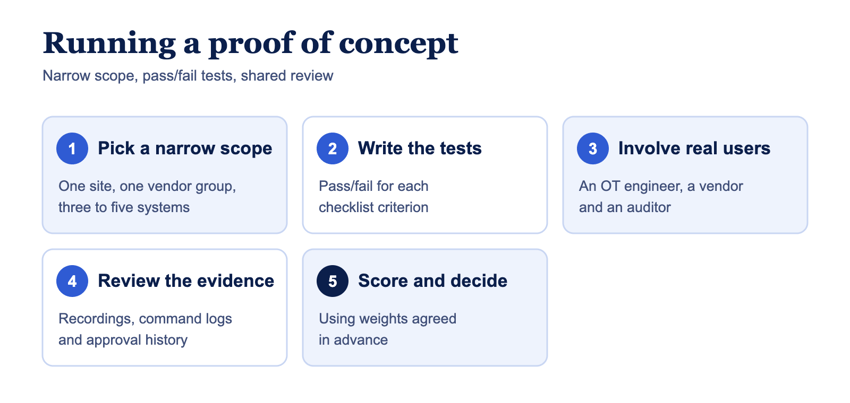
- Pick a narrow scope: one site, one vendor group and three to five target systems.
- Write pass/fail tests for each checklist criterion before installation.
- Involve the people who will use it: an OT engineer, a vendor and an auditor.
- Review the evidence together: recordings, command logs and approval history.
- Score and decide with weights agreed in advance, so the result reflects your priorities.
How Safous fits the checklist
Safous Privileged Remote Access is an agentless privileged remote access platform for IT, OT and IoT, provided by IIJ (Internet Initiative Japan). It deploys a gateway in under 10 minutes, keeps credentials, logs and recordings in your environment, and supports isolated OT sites. Use the at-a-glance fact sheet as the capability reference during your evaluation, and the product page for architecture details.
Frequently asked questions
What is the difference between privileged remote access and privileged access management?
Privileged access management (PAM) is the broader discipline of controlling privileged accounts, including vaulting, rotation and endpoint privilege. Privileged remote access (PRA) focuses on how administrators, vendors and OT engineers connect to critical systems remotely: brokered sessions, MFA, approvals, credential injection and session recording, without placing the user on the network.
Which privileged remote access features matter most for an audit?
Auditors usually ask for named identities with MFA, evidence of approval for each privileged session, time limits on access, session recordings or command logs, and proof that vendor access ends when work ends. Check that each of these is produced automatically and can be searched and exported.
How should OT environments be evaluated differently from IT?
OT evaluations add non-disruption and isolation requirements: no agents on controllers or HMIs, support for legacy protocols such as VNC and Telnet, no inbound connections into the control network, operation at isolated or air-gapped sites, and supervised sessions for vendor maintenance. Frameworks such as ISA/IEC 62443 and NIST SP 800-82 are common references.
How long should a privileged remote access proof of concept take?
A focused proof of concept typically covers one site, one vendor group and three to five target systems. If the gateway deploys quickly, most of the time goes into defining policies and reviewing recordings and logs with the audit and OT owners, so plan for days to a few weeks rather than months.
Test the checklist on your own systems
The fastest way to compare options is to run the checklist against a real site and vendor. Get started with Safous to set up a proof of concept.
Subscribe with Safous
Receive the latest news, events, webcasts and special offers!
Share this
Remote Access Compliance: How to Meet Audit Requirements Without Agents or VPNs
Remote Access Compliance: How to Meet Audit Requirements Without Agents or VPNs
Oct 29, 2026
3
min read
Industrial Cybersecurity Solutions: Categories and How to Evaluate Them
Industrial Cybersecurity Solutions: Categories and How to Evaluate Them
Nov 05, 2026
5
min read
How to Implement Agentless Privileged Remote Access for IT and OT: Step by Step
How to Implement Agentless Privileged Remote Access for IT and OT: Step by Step
Nov 10, 2026
7
min read