






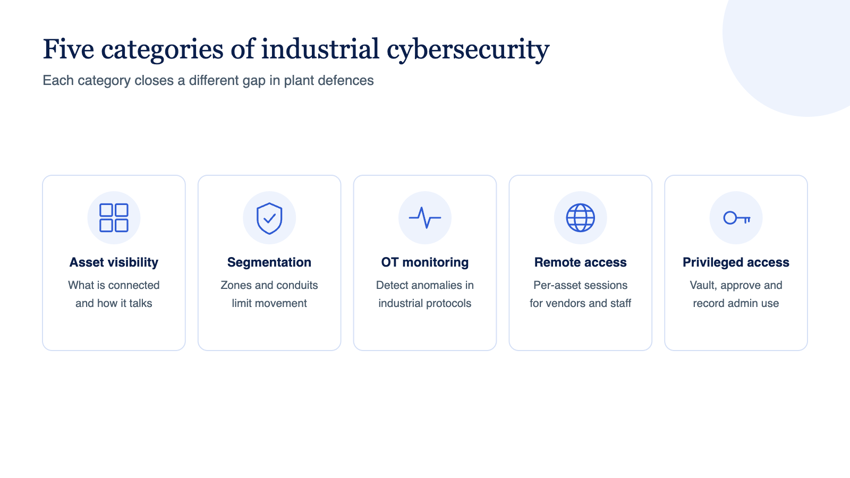
Industrial cybersecurity solutions fall into five main categories: asset visibility, network segmentation, OT network monitoring, secure remote access and privileged access management. Each one closes a different gap in a plant's defences, and buyers in manufacturing, energy and utilities usually need several of them. This guide explains what each category does and gives an evaluation table you can use when comparing products.
For definitions of operational technology and how it differs from IT, see What is OT security. This article focuses on solution categories and evaluation criteria.
What are industrial cybersecurity solutions?
Industrial cybersecurity solutions are tools and services that protect industrial control systems, such as PLCs, SCADA, DCS and HMIs, without interrupting production. They differ from IT security tools because they must work with legacy devices that cannot run agents, with industrial protocols, and with plants that cannot be rebooted for a patch.
NIST SP 800-82 Rev. 3 frames OT security around reliability and safety as well as confidentiality, and the ISA/IEC 62443 zones and conduits model is the common reference for structuring industrial networks. Both are useful baselines when deciding which categories a site needs.
Categories of industrial cybersecurity solutions
The five categories map to the questions every plant must answer: what is connected, how traffic is separated, how attacks are detected, who can connect from outside, and how privileged accounts are controlled. The table summarises each one with the questions to ask vendors.
Asset visibility and OT monitoring
Asset visibility and monitoring tools are usually deployed together, often from the same platform, because both rely on passive analysis of industrial traffic. Their output, an accurate inventory and a baseline of normal communication, feeds every other control.
Segmentation
Segmentation limits how far an attacker can move once inside. In ISA/IEC 62443 terms, systems with similar security requirements are grouped into zones, and every connection between zones passes through a controlled conduit. Remote access is one of the most important conduits to control.
Secure remote access and PAM
Secure remote access and PAM overlap in industrial environments because most privileged activity in a plant happens remotely, often by OEM and maintenance vendors. Treating them as one control point, which verifies the user, limits the session to one asset and records it, reduces the number of tools operators must manage. The agentless remote access article explains why agentless designs suit legacy OT.
How to evaluate industrial cybersecurity solutions
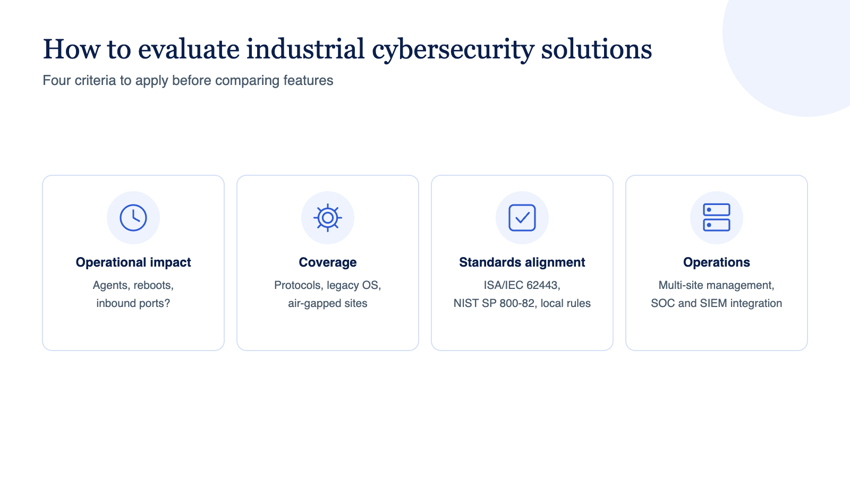
Evaluate industrial cybersecurity solutions on four criteria: operational impact, coverage of the plant's devices and protocols, alignment with standards and regulations, and the effort required to run them. A product that is strong in features but requires agents on controllers or plant downtime is often not deployable.
- Operational impact. Does it need agents, reboots, inbound firewall rules or network re-addressing?
- Coverage. Does it support the protocols and operating systems in the plant, including legacy Windows and serial-to-IP gateways?
- Standards alignment. Can it produce evidence for ISA/IEC 62443, NIST SP 800-82 and local regulations such as Singapore's CCoP or Malaysia's Cyber Security Act 2024?
- Operations. Can a small OT team run it across many sites, and does it integrate with the SOC and SIEM?
For remote access specifically, the comparison below shows how common approaches perform against these criteria.
How Safous fits into an industrial cybersecurity stack
Safous covers the secure remote access and privileged access categories for IT, OT and IoT, and works alongside asset visibility, segmentation and monitoring tools. It brokers each session through Safous Global Access Points and Safous AppGateway, which runs on a Linux host, VM or cloud instance at the site and connects outbound, so no inbound ports are opened and credentials, logs and recordings stay in the customer environment.
- Agentless browser access to HMIs, engineering workstations and servers over RDP, SSH, VNC, Telnet, SMB and HTTP/HTTPS.
- MFA, device posture checks, just-in-time access and multi-level approvals for vendor sessions.
- Credential vaulting and injection, so vendors never see plant passwords.
- Live monitoring, session termination, recording and SIEM integration for audit evidence.
- Private PoP and isolated AppGateway options for air-gapped OT networks.
See industrial secure remote access, Safous for manufacturing and the ISA/IEC 62443 checklist. For architecture patterns, read designing OT secure remote access architecture.
Frequently asked questions
What are the main categories of industrial cybersecurity solutions?
The main categories are asset visibility and inventory, network segmentation, OT network monitoring and threat detection, secure remote access, and privileged access management. Most industrial programmes also include vulnerability management and backup and recovery. Each category addresses a different stage of the attack path, so they are used together rather than as alternatives.
Which industrial cybersecurity solution should a plant deploy first?
Most plants start with asset visibility, because segmentation, monitoring and access policies all depend on knowing which devices exist and how they communicate. Where third-party vendors already connect to the plant through VPNs or remote desktop tools, securing that remote access is usually the second priority, as it is a direct path into control systems.
How do you evaluate an industrial secure remote access solution?
Evaluate whether it needs agents on controllers or engineering workstations, whether it requires inbound firewall ports, how it verifies users and devices, whether access can be limited to a single asset and time window, and whether sessions are recorded. It should also support the protocols used in the plant, such as RDP, SSH and VNC, and work in isolated or air-gapped networks.
Is a VPN enough for remote access to OT systems?
A VPN on its own places the user on the network, which allows movement beyond the system they need to reach. Industrial guidance such as ISA/IEC 62443 recommends separating systems into zones and controlling the conduits between them, so remote access is usually brokered per asset, with MFA, approval and session recording, rather than given at network level.
Evaluate secure remote access for your plants
Safous is provided by IIJ (Internet Initiative Japan) and deploys in under 10 minutes. Talk to Safous to assess how secure remote access fits into your industrial cybersecurity programme.
Subscribe with Safous
Receive the latest news, events, webcasts and special offers!
Share this
Agentless Remote Access for IT, OT and IoT: How It Works and When to Use It
Agentless Remote Access for IT, OT and IoT: How It Works and When to Use It
Oct 22, 2026
4
min read
Remote Access Compliance: How to Meet Audit Requirements Without Agents or VPNs
Remote Access Compliance: How to Meet Audit Requirements Without Agents or VPNs
Oct 29, 2026
3
min read
Why Human-Approved Access Matters for AI-Automated Operations
Why Human-Approved Access Matters for AI-Automated Operations
Nov 26, 2025
5
min read