














Factories, power grids, ports and mines all run on operational technology (OT). These systems keep production safe, steady and profitable. As companies depend more on OT, the damage from a breach grows too.
Cyberattacks targeting OT grew by 140% in 2022, hitting more than 150 industrial organizations.1 Analysts expect that cyber threats may shut down 15,000 industrial sites throughout 2028.2
OT attacks often do more than delay operations. Some major OT security incidents in 2022 led to:1
- A fire that damaged equipment during an attack on a mining company.
- Problems loading and unloading cargo, fuel and bulk oil at six seaports on three continents.
- Delayed flights for tens of thousands of passengers after attacks on four air travel companies.
OT is the base of critical infrastructure and of the processes that earn revenue in industry. Securing it is now essential. Without it, companies face operational, financial and safety risks.
In this blog, we explain what operational technology is and how it differs from information technology. We also explain why businesses need to secure IT and OT together. To see how this works for plants and remote vendors, see OT remote access with Safous.
What Is Operational Technology?
Operational technology is the hardware and software that runs industrial processes. You find it in manufacturing, energy, oil and gas, robotics and other industries. Common types of OT include:
- Industrial Control Systems (ICS): manage and automate processes such as manufacturing, product handling and utilities.
- Supervisory Control and Data Acquisition (SCADA) systems: collect sensor data and control assets spread across wide areas.
- Distributed Control Systems (DCS): automate and control a process within one site or plant.
These systems drive physical equipment such as valves, switches, motors and pumps. OT puts safety, availability and steady uptime first. Any downtime can hurt operations and profits.
What Is Information Technology?
Information technology (IT) covers the computing systems that store, send and receive data. In business, IT means the software, networks and computers that people use to communicate and get work done. Common IT systems include:
- Laptops, desktops, smartphones, tablets and peripherals
- Servers, storage systems and networking equipment
- Cloud platforms and web-based software
- Operating systems, business applications and databases
Uptime matters in IT. But the top priority for most IT teams is keeping data confidential and accurate.
What Are the Differences Between OT and IT?
OT and IT do different jobs and have different priorities.
OT controls physical devices and processes. It runs in places like manufacturing plants, utilities, and oil and gas facilities. Its main goal is to keep machines running safely and without a break, so the business can make products or deliver services.
IT protects data. Its top priorities are the confidentiality, integrity and availability of information, known as the CIA triad. Uptime matters, but IT mainly works to stop data breaches, data loss and service outages.
The two networks are also built differently:
- IT networks usually include segmentation, identity and access controls, and detailed logging and monitoring.
- Traditional OT networks were often built flat, without segmentation. This let staff reach any system from anywhere for support and monitoring.
Why Do Businesses Need Security for OT and IT?
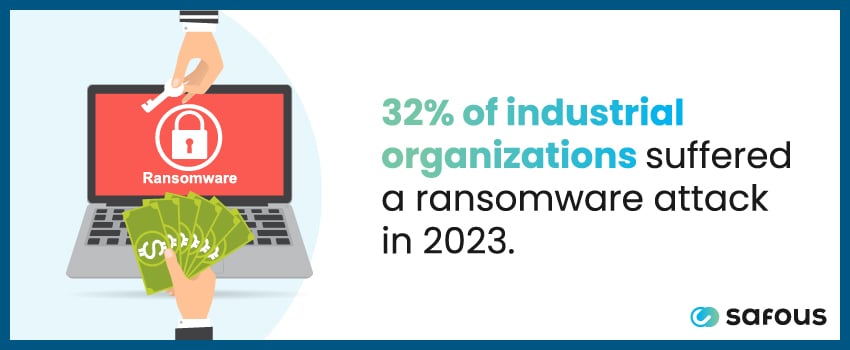
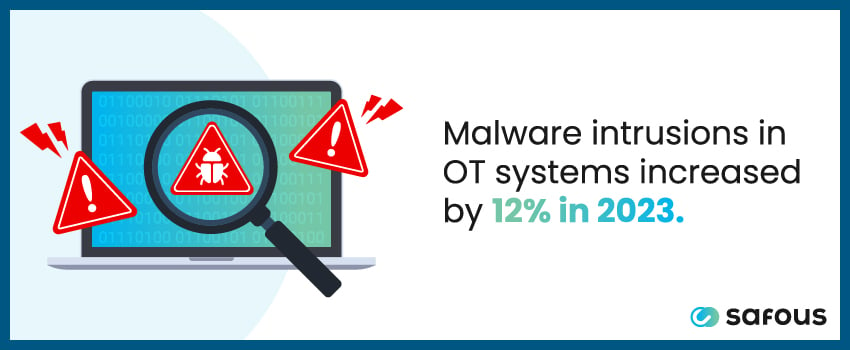
A 2023 survey found that 32% of industrial organizations experienced a ransomware attack, while malware intrusions rose by 12%.3 These numbers show why OT and IT need to be secured together.
OT runs the processes that keep a business operating. IT holds sensitive data such as intellectual property, customer details and financial records. If attackers steal or damage this data, the financial and reputational harm can be severe.
OT and IT are now more closely connected than ever. Each new link gives attackers another way into industrial networks.
What Is OT Security?
OT security protects the systems that control and automate physical industrial processes. Its core goals are listed below.
Ensuring System Availability
OT systems must stay available and reliable. An unplanned outage stops production and revenue right away.
Redundancy, resilience to disruption and disaster recovery all help keep assets available.
Protecting Against Unauthorized Access
Keeping unauthorized users away from OT devices and networks helps prevent attacks and breaches.
Authentication, network segmentation and secure remote access controls all reduce the paths an attacker can use.
Guarding Against Malware
Industrial malware can change or disrupt OT processes. Several layers of defense work best:
- Anti-malware tools built for control systems
- A strong patching process
- Anomaly detection tools
Enabling Secure Remote Access
Staff and vendors often need remote access to OT for monitoring and maintenance. Secure remote access tools give them that access while keeping control, without growing the attack surface.
Segmenting OT Networks
Separating OT networks from other environments helps contain threats. It also limits how far an attacker can move after a breach.
Segmentation makes it easier to monitor traffic between trust zones, too.
Detecting Anomalies
Security teams and automated tools can collect and analyze OT system data. This helps them spot attacks or process problems faster.
Machine learning can compare this data with normal operations to find anything that looks different. Monitoring OT traffic and process values in real time lets teams spot unusual commands before they affect physical equipment.
Maintaining Regulatory Compliance
Industry standards and regulations help keep critical infrastructure secure. Common references include:
- ISA/IEC 62443 for industrial automation and control systems
- NIST SP 800-82 Rev. 3 (Guide to Operational Technology Security)
- NERC CIP for North American electric utilities
- National critical infrastructure regulations across ASEAN
These standards cover system hardening, network segmentation, access control and monitoring.
OT Security vs. IT Security
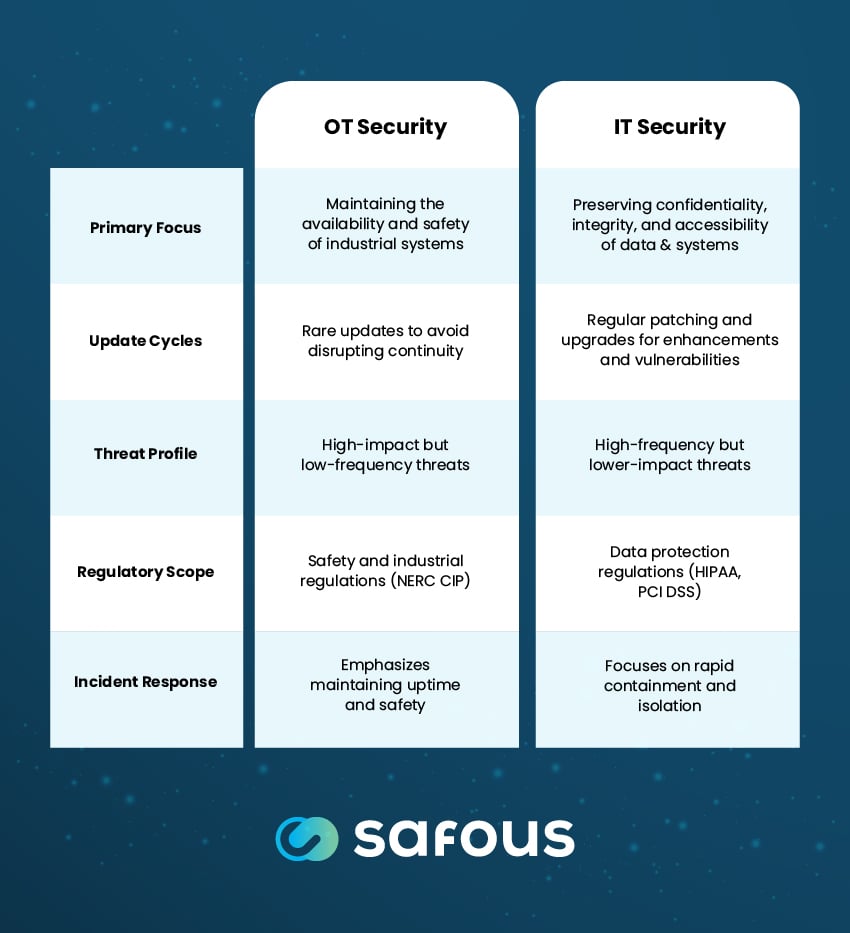
OT and IT security protect different environments. They also go about it in different ways. Here are the key differences:
Primary Focus
OT security puts availability and safe operation first. A disruption can stop manufacturing, cause utility outages and cost a lot of money. So the goal is to keep the control systems that run physical processes working at all times.
IT security puts data first. It protects the confidentiality, integrity and availability of data and information systems. The main aim is to prevent breaches, data loss and service outages.
Update Cycles
OT systems rarely get software or firmware updates. Updates can mean downtime, and downtime can disrupt time-sensitive physical processes. As a result, many OT components keep running old or vulnerable versions.
IT systems get regular patches, updates and upgrades. These fix security flaws, add features and improve performance. Strict change management keeps downtime low during updates.
Threat Profile
OT environments are highly specialized, which limits the number of threats. But attacks are becoming more frequent.
When an OT attack succeeds, the impact is high. Attackers often use insider credentials or make small changes over time. These changes can lead to major physical damage.
IT threats happen more often but usually cause less damage per incident. They tend to use external remote access paths and malware to steal data. Still, because IT systems are so connected, an IT attack can also cause operational downtime.
Regulatory Scope
Industrial businesses face physical safety risks. So OT systems must meet special safety rules, such as the NERC CIP standards for North American electric utilities and power generators.
OT systems also use their own protocols, such as Modbus and DNP3. These are rarely found in IT environments.
IT compliance focuses on data protection laws. Examples include HIPAA for health data, PCI DSS for payment card data, and various state and federal privacy laws.
Incident Response
OT incident response focuses on uptime and physical safety. Production needs often make it impossible to isolate or fully shut down OT systems. So the response is careful, and systems are restored step by step.
IT incident response aims to contain threats fast. Teams isolate affected systems to stop more data loss, even if that means shutting down apps and services. Speed matters most, to stop the threat from spreading across connected systems.
Why Do Businesses Need OT Security?
In the past, OT ran on isolated, proprietary networks with no outside connection. Industry 4.0 changed that. Companies have added IoT sensors, manufacturing analytics and remote monitoring to OT that used to be isolated.
This connected data can help improve processes. But it also widens the attack surface.
OT networks now use more general computers and operating systems instead of special industrial parts. If these are unpatched or poorly configured, outside attackers can use them to reach OT environments that used to be separate.
Closer links between OT and corporate IT create another risk. Attackers can break into an IT system first, then move into weak OT devices. A successful attack can halt industrial processes, causing instant revenue loss and damage to assets.
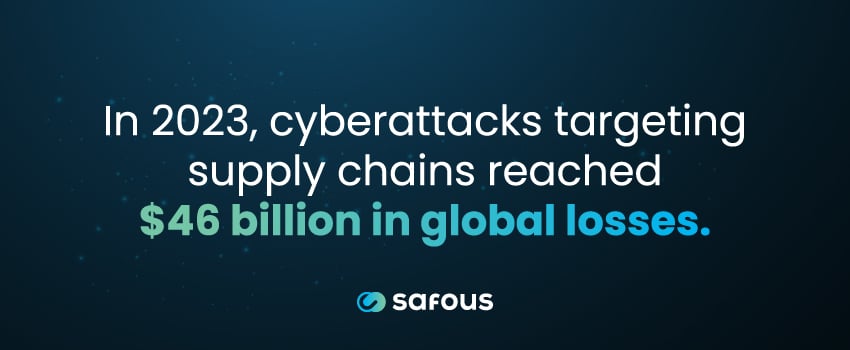
The impact can spread further. When one supplier is compromised, the whole supply chain suffers. Supply chain attacks caused $46 billion in losses in 2023.4
OT Security Best Practices
Industrial organizations can follow these best practices to secure their OT environments:
Identify All Connected Assets
You can't protect what you can't see. Keep an inventory of every connected OT system and component, and update it often.
Good visibility also makes it easier to assess risk, set up access controls and monitor your systems.
Segment and Control Network Traffic
Allow only the network connections you need, and watch traffic for signs of threats. If traffic between secure and less secure zones goes unchecked, attackers can move freely across your OT network.
Harden OT Devices
Use secure configurations, manage patches and turn off services you don't need. These steps help prevent breaches. They also limit the damage if an attacker does get in.
Monitor for Anomalies
Collect and analyze OT system data so you can detect attacks or process problems quickly. Machine learning models trained on normal operations can flag unusual activity that may signal a new threat.
Limit Privileged Access
Give OT access only to the people who truly need it. Enforce multi-factor authentication (MFA) and limit movement between zones. This reduces the harm any one insider can do.
Backup Critical Parameters
Back up important OT data and configurations. Backups let you restore systems quickly after an outage or data corruption. They also cut downtime and support forensic work after an incident.
Privileged Access Management for OT Environments
Privileged access is one of the riskiest paths into OT. Equipment vendors, system integrators and remote engineers need admin access to PLCs, HMIs, SCADA servers and engineering workstations.
This access often runs through shared VPN accounts, always-on remote desktop tools or open firewall ports. In that setup, one stolen password can reach the entire control network.
Traditional privileged access management (PAM) tools were built for IT servers. Many rely on agents or network-level connections. But many OT systems cannot run agents, and equipment vendors may not allow changes to validated systems.
So OT privileged access needs controls that work without changing the assets themselves:
- Agentless, browser-based access: nothing is installed on industrial systems or on the vendor's device.
- Asset-level least privilege: users reach only the systems they maintain, not the whole OT network.
- Just-in-time, time-bound access: vendor access is approved for a maintenance window and removed automatically.
- Session monitoring and recording: every privileged session is logged and can be replayed for audits and incident response.
- No inbound firewall ports: outbound-only gateways keep the OT network closed to the internet.
Learn more in Agentless Remote Access for IT, OT and IoT and the Privileged Remote Access Guide.
How to Secure Remote and Privileged Access to OT: Step by Step
- Identify critical OT assets and how they connect. List your PLCs, HMIs, SCADA and historian servers. Map who connects to them and how.
- Apply network segmentation. Separate OT zones and conduits from IT. Follow the zone-and-conduit model in ISA/IEC 62443.
- Remove shared and standing access. Replace shared vendor accounts and always-on VPN access with named identities and MFA.
- Grant access per asset and per time window. Approve vendor access to specific systems only for scheduled maintenance.
- Record and review privileged sessions. Keep session recordings and audit logs for compliance and investigations.
- Review access regularly. Remove users and vendors who no longer need access. Test your incident response plan for OT scenarios.
Frequently Asked Questions About OT Security
What is OT security?
OT security protects the hardware and software that monitor and control physical industrial processes, such as ICS, SCADA and DCS. It focuses on safety, availability and reliable operation.
How is OT security different from IT security?
IT security puts the confidentiality and integrity of data first. OT security puts continuous, safe operation first. OT systems are patched less often, use industrial protocols like Modbus and DNP3, and cannot always be shut down during an incident.
How do you secure remote access to OT systems?
Use privileged remote access that gives each user access only to specific assets. It should enforce MFA, limit vendor access to approved time windows, record sessions and avoid opening inbound firewall ports into the OT network.
Which standards apply to OT security?
ISA/IEC 62443 and NIST SP 800-82 are the most widely used OT security frameworks. Sector rules such as NERC CIP and national critical infrastructure laws also apply in many regions.
Bolster Your Organization’s OT Security With Safous
Industrial firms keep connecting IT and operational technology systems. That makes strong cybersecurity critical. Legacy remote access tools do not protect OT infrastructure and supply chains well enough.
Safous replaces VPNs and jump servers for OT and IT remote access. Engineers and vendors reach only the specific systems they need, and every session is monitored and recorded.
You do not need to connect your isolated OT network directly to the internet. The on-premises Safous AppGateway runs inside your OT network and makes outbound-only connections, so no inbound firewall ports are needed. Safous also does not update your systems automatically, which protects operational uptime.
Ready to see Safous in action? Book a demo today.
Related Resources
- Safous Industrial Secure Remote Access (I-SRA) at a Glance
- ISA/IEC 62443 Compliance Checklist
- Secure Remote Access for Manufacturing (Industry 5.0)
Sources:
- https://securityintelligence.com/news/high-impact-attacks-on-critical-infrastructure-climb-140/
- https://industrialcyber.co/reports/waterfall-2023-threat-report-detects-ot-cyberattacks-with-physical-consequences-increasing-exponentially/
- https://www.fortinet.com/content/dam/fortinet/assets/reports/report-state-ot-cybersecurity.pdf
- https://cybersecurityventures.com/software-supply-chain-attacks-to-cost-the-world-60-billion-by-2025/
Subscribe with Safous
Receive the latest news, events, webcasts and special offers!
Share this
Why SASE Doesn’t Meet OT Security Needs, and What to Do Instead

Why SASE Doesn’t Meet OT Security Needs, and What to Do Instead
Jan 08, 2026
5
min read
From Industry 4.0 to 5.0: Securing Supply Chains in the Human-AI Era
From Industry 4.0 to 5.0: Securing Supply Chains in the Human-AI Era
Oct 28, 2025
5
min read
Agentless Remote Access for IT, OT and IoT: How It Works and When to Use It
Agentless Remote Access for IT, OT and IoT: How It Works and When to Use It
Oct 22, 2026
4
min read