

A vendor remote access policy defines how external users may connect to an organization’s systems, who approves their access, what they may do, and when that access must end. It should also specify authentication, session oversight, data handling, emergency access, and exception requirements.
To write an effective policy, start with the vendor’s business purpose and target systems. Assign accountable owners, define enforceable access conditions, and document how the organization will verify those conditions.
A support contract may authorize a supplier to maintain equipment. It does not automatically authorize every technician to connect to every supported system at any time.
This guide provides a practical policy template, an access inventory worksheet, and guidance for applying the policy across IT and OT environments.
What Should a Vendor Remote Access Policy Include?
A vendor remote access policy should answer ten questions:
- Which vendors, users, systems, and access methods are covered?
- Who owns the vendor relationship and approves access?
- How is each individual identified and authenticated?
- Which connection methods are permitted?
- What resources and privileges may the vendor use?
- When does authorization begin and end?
- How are sessions monitored and recorded?
- How may files and data move?
- How are emergencies and exceptions handled?
- How is access reviewed, revoked, and evidenced?
These requirements translate access governance into operating rules. For the underlying principles, see What Is Access Governance? Why Third-Party Access Needs a Different Model.
The policy should distinguish between an approved vendor relationship, an individual’s eligibility for access, and authorization for a specific session.
Start with Scope and an Access Inventory
Before drafting requirements, identify the external access paths already in use.
Include managed service providers, system integrators, equipment manufacturers, maintenance contractors, external administrators, and relevant subcontractors.
Cover the systems they can reach: production applications, cloud consoles, servers, repositories, engineering workstations, and industrial environments. Include temporary support connections and remote-management tools.
Define how non-interactive vendor integrations are handled. API credentials and service accounts may require a separate standard, but they should remain under governance.
NIST’s remote access and BYOD guidance addresses employees, contractors, business partners, vendors, and both organization-issued and personal devices. This supports considering the user, device, and access method together when defining policy scope.
Vendor Access Inventory Worksheet
Use the inventory to record the actual access path, including connections that do not yet meet policy.
| Field | Example value | Accountable role |
|---|---|---|
| Vendor and named user | Equipment supplier and individual maintenance engineer | Vendor sponsor |
| Contract or work authorization | Active support agreement or approved work order | Vendor sponsor/procurement |
| Business purpose | Troubleshoot a documented equipment fault | Business owner |
| Asset and environment | Specific production application or OT workstation | Asset owner |
| Access path | Approved access gateway or industrial DMZ route | IT/OT administrator |
| Authentication and source device | Named identity, approved MFA, vendor-managed laptop | Identity/security owner |
| Privilege scope | Diagnostic access with separately approved elevation | Asset owner |
| Access window | Ticket-linked start and end time | Business or operations owner |
| Data sensitivity and transfers | Confidential data; approved diagnostic-file transfer | Data/asset owner |
| Expiry or revocation trigger | Window ends, task closes, or technician assignment ends | Access administrator |
A supplier’s approval should not automatically authorize all its personnel. Each technician should have an individually attributable identity and access that can be revoked independently.
Define Roles and the Approval Workflow
The policy should separate approval of the business need from implementation of the access decision.
Roles may be combined in smaller organizations, but ownership should remain explicit:
- Requester: supplies the task, target systems, requested permissions, and duration.
- Vendor sponsor: validates the relationship and the named technician.
- Business or asset owner: approves the need and scope; for OT, considers operational impact.
- Security reviewer: evaluates control requirements and exceptions according to risk.
- Access administrator: implements the approved permissions and expiry.
- Risk owner: accepts documented exceptions where required.
Use an Approval Sequence That Matches the Risk
The workflow below illustrates request submission, owner approval, security review, and administrative authorization.
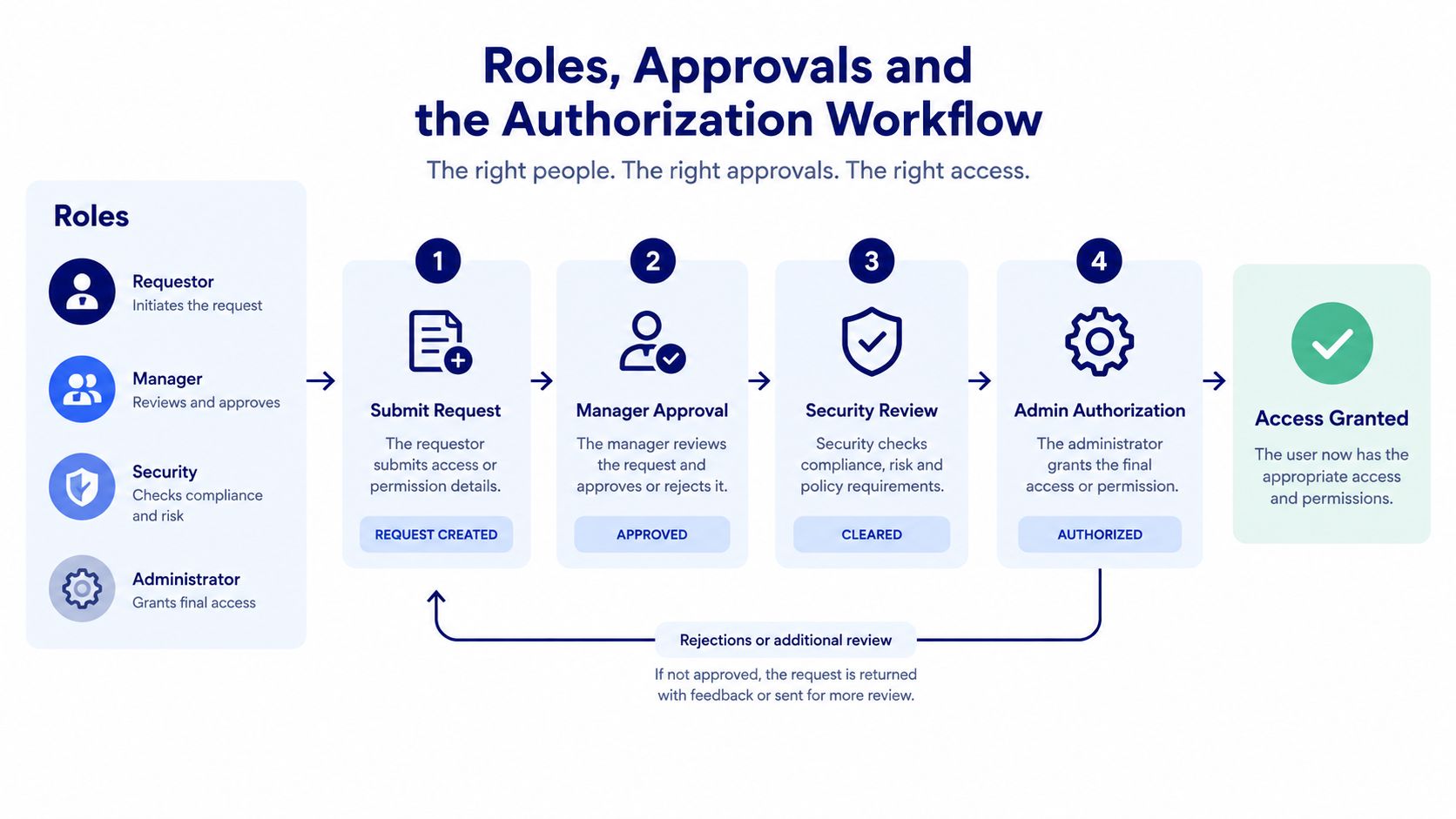
For vendor access, the “manager” role should map to the designated internal sponsor or asset owner. Administrative authorization means implementing an approved decision; it should not replace business approval.
Routine requests within an approved scope may follow a streamlined process. New vendors, privileged changes, sensitive data access, OT work, and exceptions may need additional review.
The policy should state which review is required for each category.
Vendor Remote Access Policy Template
The following sample wording provides a starting point for an internal policy. Replace the bracketed fields and align the requirements with your systems, risk decisions, and operating procedures.
1. Purpose and Scope
Sample policy wording
This policy governs remote access by external suppliers, contractors, service providers, and authorized subcontractors to [organization name] systems and data.
It applies to the identities, devices, connection methods, and target environments used for that access, including IT and OT systems. Non-interactive integrations are governed by [referenced standard].
All vendor access must have a documented business purpose, an accountable internal owner, approved scope, and defined expiry or revocation conditions.
2. Ownership and Vendor Responsibilities
Sample policy wording
Each vendor relationship must have an internal sponsor responsible for validating access needs and reporting changes.
Vendors must identify the individuals requiring access and notify [designated contact] of personnel departures, reassignment, suspected compromise, or other relevant changes within [notification period].
Subcontractors require explicit authorization. Approval of a supplier does not automatically authorize additional personnel.
3. Access Requests and Approval
Sample policy wording
Access requests must identify the technician, supplier, sponsor, target resource, task, required privileges, access method, and requested duration.
The designated business or asset owner must approve access before provisioning. Additional security or operational review is required for [defined high-risk categories].
Changes to approved targets, privileges, or duration require renewed approval. An access administrator may provision only the approved scope.
4. Identity, Authentication, and Devices
Sample policy wording
Interactive vendor access must be attributable to a named individual. User identities and authentication factors must not be shared.
Remote access must use MFA meeting [organization authentication standard]. Phishing-resistant methods should be used where supported and required by that standard.
Approved devices must meet [vendor device requirements]. Where device posture cannot be verified, the organization must apply defined restrictions or obtain an approved exception before granting access.
If a target system requires a shared account, access must still be attributable to the individual through an approved broker or equivalent control.
5. Approved and Prohibited Access Methods
Sample policy wording
Vendor connections must use the approved methods listed in [access methods register] and be restricted to authorized resources.
Direct internet exposure, unapproved remote-management tools, persistent support tunnels, and bypasses of approved access controls are prohibited unless covered by a documented exception.
A VPN connection, where permitted, must be accompanied by appropriate resource restrictions and access controls. Network connectivity alone does not authorize access to other systems.
6. Privilege and Access Duration
Sample policy wording
Permissions must be limited to the approved task. Administrative privileges must not be granted where diagnostic or read-only access is sufficient.
Temporary authorization must specify a start condition and expiry. The maximum authorization period is [period by access category]; extensions require approval.
Where supported, permissions should be enabled just in time for the approved work. The access procedure must define both the expiry of authorization and the treatment of sessions already in progress.
7. Session Oversight and Recording
Sample policy wording
Vendor access must generate records identifying the user, target, session time, and relevant approval.
Privileged or otherwise high-risk sessions must be monitored and recorded according to [session monitoring standard], subject to supported access methods and approved exceptions.
Authorized personnel must be able to intervene according to documented procedures. For operational systems, session termination must account for safety and service continuity.
Recording access must be restricted to authorized reviewers. Vendors must receive the required notice of monitoring and recording.
8. File Transfer and Data Handling
Sample policy wording
Files may be transferred only through approved mechanisms and for the authorized task.
Transfers must follow [data classification and inspection requirements], including malware inspection and logging where applicable. Clipboard use, downloads, and local storage must follow the restrictions assigned to the access category.
Vendor-held organizational data must be returned, retained, or securely deleted according to the contract and [data handling standard].
9. Emergency Access and Exceptions
Sample policy wording
Emergency access must use the designated escalation process, named individuals, limited scope, and a defined expiry. The process must specify who may authorize urgent access and when post-event review must occur.
Exceptions must document the affected requirement, business justification, risk, compensating controls, accountable owner, approver, and expiry.
Emergency access and technical limitations must not create indefinite access. Exceptions must be reviewed by [role] at [cadence] and closed or renewed through approval.
10. Review, Revocation, and Evidence Retention
Sample policy wording
Access must be reviewed at [risk-based cadence] and when the vendor relationship, personnel, task, or target scope changes.
Access must be revoked within [defined timeframe by trigger] when no longer authorized. Revocation procedures must address relevant accounts, groups, access profiles, credentials, and active sessions.
Access records and recordings must be retained for [period by evidence type], with defined storage, integrity protection, reviewer permissions, and deletion procedures. Incident holds must follow [evidence preservation procedure].
The policy owner must review this policy at [cadence] and after material changes or incidents. Violations must be escalated through [response process].
How Should the Policy Differ for IT and OT?
Use one governance framework, but define access paths and intervention procedures for each environment.
OT requirements may include legacy compatibility, restricted connectivity, maintenance windows, local supervision, and safety review. A control suitable for a cloud application may behave differently on an engineering workstation.
A fully air-gapped system has no live external connection. Access from a local maintenance station inside that environment is different from remote access through an approved external route. Document that distinction rather than treating all isolated environments alike.
IT and OT Access Requirements
| Dimension | IT access path | OT / isolated-site requirements |
|---|---|---|
| Primary access model | Approved application or host access through a controlled broker | Approved industrial access route; local supervised maintenance for fully disconnected systems |
| Network reach | Resource- and protocol-specific restrictions | Restricted pathways between zones; no unapproved bridges to production |
| Endpoint approach | Defined device requirements and posture checks where available | Approved maintenance devices with compatibility and operational validation |
| Privilege | Task-specific permissions and temporary elevation | Task-specific permissions with asset or plant-owner approval |
| File transfer | Approved transfer with inspection and logging | Approved transfer boundary or controlled media process |
| Operations concern | Data exposure, service continuity, and lateral movement | Safety, uptime, legacy compatibility, and recovery procedures |
| Emergency method | Designated urgent approval and session oversight | Operational approval, supervision, and a safe intervention plan |
For OT requests, document whether the work involves observing a system, changing configuration, or using engineering tools. Those tasks can require different privileges and oversight.
Test how access will be revoked or isolated before authorizing sensitive work. Immediate disconnection is not always operationally safe.
For more context, see Securing Third-Party Vendor Access in OT Environments.
Turn the Policy into Operating Records
The policy establishes the rules. Supporting forms and procedures make those rules usable.
Vendor Access Request Form
Include these fields:
- Vendor company and named technician.
- Internal sponsor and asset owner.
- Contract, work order, or ticket reference.
- Task and business justification.
- Target systems and requested privileges.
- Approved access method and device type.
- Start time, end time, and time zone.
- Required file transfers.
- Approval and any exception reference.
A request should provide enough information to decide what access is justified. “Vendor needs server access” is not sufficient scope.
Exception Register
Record the unmet requirement, affected user and system, reason, risk, compensating controls, owner, approver, expiry, and closure evidence.
A description such as “legacy system” explains a constraint but does not identify a compensating control. Controls might include a shorter window, local supervision, restricted targets, and a post-session review.
Revocation Checklist
When authorization ends, the administrator should:
- Remove the relevant permissions and access profiles.
- Disable the external identity where the organization owns it, or remove its authorization where the identity is externally managed.
- Address active sessions according to the applicable intervention procedure.
- Remove related group memberships and unnecessary persistent connections.
- Rotate exposed or shared target credentials where required.
- Preserve the relevant evidence and record completion.
For a detailed process, see the Vendor Offboarding Checklist.
How Do You Verify That the Policy Works?
Test each important policy requirement against system behavior and retrievable evidence.
For example, approve a named technician for one application during a limited window. Verify that the technician can perform the authorized task, cannot reach an unrelated resource, and cannot reconnect after authorization expires.
Also check whether the reviewer can connect the request, approval, identity, target, and session evidence.
Measure new-connection blocking separately from active-session termination. These are distinct controls and may have different operational requirements.
Suggested Policy Metrics
The following are example objectives, not universal regulatory requirements. Set targets and review intervals according to your risk and operating model.
| Metric | Example objective | Review cadence | Accountable role |
|---|---|---|---|
| Vendor identities with an owner and current justification | All in-scope identities | At onboarding, changes, and periodic review | Vendor sponsor |
| MFA coverage | All in-scope remote access, with documented exceptions | Continuous checks; periodic reporting | Identity owner |
| Sessions linked to an approval or authorized work record | All sessions requiring approval | Periodic sampling | Access / operations owner |
| Unjustified standing privileged access | None | Risk-based periodic review | Privileged access owner |
| Expiry and revocation performance | Within defined policy timeframes | Automated checks and event-based review | Access administrator |
| Exceptions with an owner and expiry | All exceptions | At issuance and before expiry | Risk owner |
| Access recertification | Completed at the defined cadence | According to policy | Business / asset owner |
| Required session evidence available | All in-scope sessions; investigate gaps | Periodic testing | Security / asset owner |
The purpose of these measures is to identify controls that need correction. A review completion percentage should not substitute for testing whether permissions actually expired.
Frequently Asked Questions
What Is a Vendor Remote Access Policy?
It is an internal policy defining how external users may access organizational systems remotely. It covers ownership, approval, identity, authentication, access scope, session oversight, data handling, and revocation.
How Do You Write a Vendor Remote Access Policy?
Inventory existing access, define accountable roles, specify enforceable requirements, and create supporting request and exception records. Then test the policy against representative vendor tasks before approving it for use.
Should Vendors Have Permanent Access?
Ongoing support may justify continuing eligibility for access. It does not necessarily justify continuously available privileges. Define when access can be activated, what it covers, and when it must expire or be reviewed.
Must Every Vendor Session Be Recorded?
The policy should specify recording requirements by risk and access method. Sensitive administrative work may warrant recording and supervision, while other access may use scoped permissions and activity logs. Document exceptions and alternative evidence where recording is unavailable.
Can a VPN Meet the Policy?
A VPN may form part of an approved access path, but it does not by itself establish task authorization, resource scope, session oversight, or expiry. Evaluate the complete connection and control model.
How Often Should Vendor Access Be Reviewed?
Set the cadence according to risk, and review access when personnel, contracts, assignments, or permissions change. Temporary access should expire according to its approved conditions rather than waiting for the next scheduled review.
Put Vendor Access Policy into Practice with Safous
A useful vendor remote access policy connects a named person, an approved task, a defined resource, and a clear end condition. Supporting technology should enforce those decisions and provide evidence that they worked.
Safous Privileged Remote Access provides policy-based application access, integrated MFA and credential vaulting, and privileged session recording, supervision, and termination. Access request/approval workflows and recording are included as standard.
Evaluate these capabilities against the access methods, approval procedures, and IT/OT requirements defined in your policy.
Subscribe with Safous
Receive the latest news, events, webcasts and special offers!